Use a calculator to find each value. Give answers as real numbers. cos (tan⁻¹ 0.5)
Verified step by step guidance
1
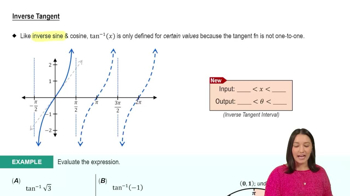
Recognize that \( \tan^{-1}(0.5) \) is the angle whose tangent is 0.5.
Let \( \theta = \tan^{-1}(0.5) \). This means \( \tan(\theta) = 0.5 \).
Use the identity \( \cos(\theta) = \frac{1}{\sqrt{1 + \tan^2(\theta)}} \) to find \( \cos(\theta) \).
Substitute \( \tan(\theta) = 0.5 \) into the identity: \( \cos(\theta) = \frac{1}{\sqrt{1 + (0.5)^2}} \).
Simplify the expression to find the value of \( \cos(\theta) \).
Verified video answer for a similar problem:
This video solution was recommended by our tutors as helpful for the problem above
Play a video:
Was this helpful?
Key Concepts
Here are the essential concepts you must grasp in order to answer the question correctly.
Inverse Trigonometric Functions
Inverse trigonometric functions, such as tan⁻¹ (arctangent), are used to find angles when the value of a trigonometric function is known. For example, tan⁻¹(0.5) gives the angle whose tangent is 0.5. Understanding how to interpret these functions is crucial for solving problems that involve finding angles from given ratios.
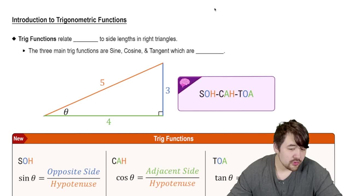
Trigonometric ratios relate the angles of a triangle to the lengths of its sides. In the context of the tangent function, it is defined as the ratio of the opposite side to the adjacent side in a right triangle. Knowing these ratios helps in calculating other trigonometric values, such as cosine, based on the angle derived from the inverse function.
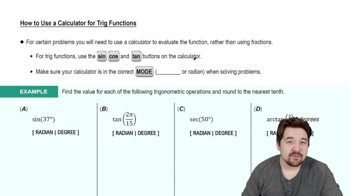
Using a calculator effectively requires understanding how to input functions and interpret the results. Most scientific calculators have specific buttons for trigonometric functions, including inverse functions. Familiarity with these functions allows for accurate calculations of trigonometric values, such as cos(tan⁻¹(0.5)), which involves first finding the angle and then calculating its cosine.