Textbook Question
Write each trigonometric expression as an algebraic expression in u, for u > 0.
cos (arcsin u)
622
views

 Lial 12th EditionCh. 6 - Inverse Circular Functions and Trigonometric EquationsProblem 95
 Verified step by step guidance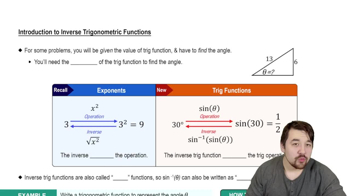
 4:28
4:28
 6:25
6:25 4:22
4:22Write each trigonometric expression as an algebraic expression in u, for u > 0.
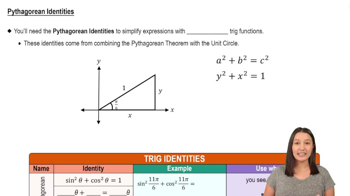
cos (arcsin u)
Write each trigonometric expression as an algebraic expression in u, for u > 0.
sin (2 sec⁻¹ u/2)
Evaluate each expression without using a calculator.
sin (sin⁻¹ 1/2 + tan⁻¹ (-3))
Use a calculator to find each value. Give answers as real numbers.
cos (tan⁻¹ 0.5)
Write each trigonometric expression as an algebraic expression in u, for u > 0.
tan (sin⁻¹ u/(√u² + 2))
Use a calculator to find each value. Give answers as real numbers.
tan (arcsin 0.12251014)