Write each trigonometric expression as an algebraic expression in u, for u > 0. sin (2 sec⁻¹ u/2)
Verified step by step guidance
1
Recognize that \( \sec^{-1} \left( \frac{u}{2} \right) \) is the inverse secant function, which means \( \sec(\theta) = \frac{u}{2} \) for some angle \( \theta \).
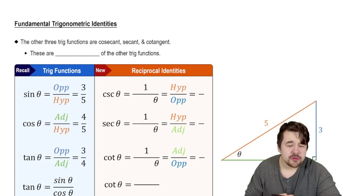
Use the identity \( \sec(\theta) = \frac{1}{\cos(\theta)} \) to find \( \cos(\theta) = \frac{2}{u} \).
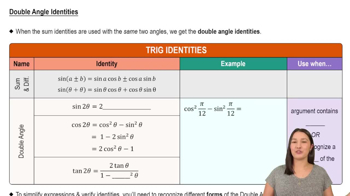
Apply the double angle identity for sine: \( \sin(2\theta) = 2 \sin(\theta) \cos(\theta) \).
Find \( \sin(\theta) \) using the Pythagorean identity: \( \sin^2(\theta) + \cos^2(\theta) = 1 \), which gives \( \sin(\theta) = \sqrt{1 - \cos^2(\theta)} = \sqrt{1 - \left(\frac{2}{u}\right)^2} \).
Substitute \( \sin(\theta) \) and \( \cos(\theta) \) into the double angle identity to express \( \sin(2\theta) \) as an algebraic expression in terms of \( u \).
Verified video answer for a similar problem:
This video solution was recommended by our tutors as helpful for the problem above
Play a video:
0 Comments
Key Concepts
Here are the essential concepts you must grasp in order to answer the question correctly.
Inverse Trigonometric Functions
Inverse trigonometric functions, such as sec⁻¹, are used to find angles when given a trigonometric ratio. For example, sec⁻¹(u/2) gives the angle whose secant is u/2. Understanding how to manipulate these functions is crucial for converting trigonometric expressions into algebraic forms.
Double angle formulas are trigonometric identities that express trigonometric functions of double angles in terms of single angles. For instance, sin(2θ) can be expressed as 2sin(θ)cos(θ). This concept is essential for simplifying expressions like sin(2 sec⁻¹(u/2)) into a more manageable algebraic form.
Trigonometric identities are equations that hold true for all values of the variables involved. Key identities, such as the Pythagorean identity and the reciprocal identities, are fundamental in transforming and simplifying trigonometric expressions. Familiarity with these identities is necessary to effectively rewrite expressions in terms of u.

 Verified step by step guidance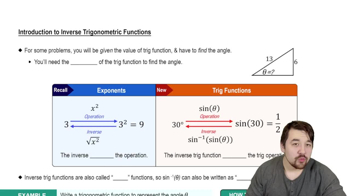
 4:28
4:28