This video solution was recommended by our tutors as helpful for the problem above
Play a video:
0 Comments
Key Concepts
Here are the essential concepts you must grasp in order to answer the question correctly.
Inverse Trigonometric Functions
Inverse trigonometric functions, such as arcsin, are used to find the angle whose sine is a given value. For example, if y = arcsin(u), then sin(y) = u. Understanding how these functions relate angles to their corresponding ratios is crucial for converting trigonometric expressions into algebraic forms.
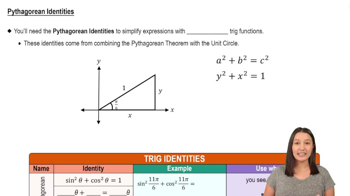
The Pythagorean identity states that for any angle θ, sin²(θ) + cos²(θ) = 1. This identity is essential when working with trigonometric functions, as it allows us to express one function in terms of another. In the context of the given expression, it helps to relate the sine and cosine of the angle derived from the inverse function.
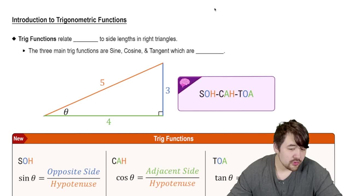
Trigonometric ratios define the relationships between the angles and sides of a right triangle. For instance, cosine is defined as the ratio of the adjacent side to the hypotenuse. When converting expressions like cos(arcsin(u)), recognizing these ratios allows us to express the cosine in terms of u, facilitating the transformation into an algebraic expression.

 Verified step by step guidance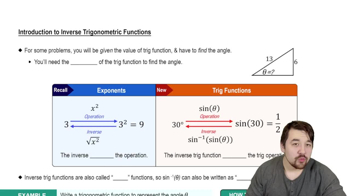
 4:28
4:28