Write each expression in terms of sine and cosine, and then simplify the expression so that no quotients appear and all functions are of θ only. See Example 3. cot² θ(1 + tan² θ)
Verified step by step guidance
1
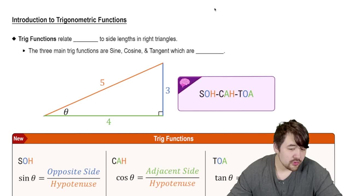
Start by expressing \( \cot^2 \theta \) and \( \tan^2 \theta \) in terms of sine and cosine. Recall that \( \cot \theta = \frac{\cos \theta}{\sin \theta} \) and \( \tan \theta = \frac{\sin \theta}{\cos \theta} \).
Substitute these expressions into the original expression: \( \frac{\cos^2 \theta}{\sin^2 \theta} (1 + \frac{\sin^2 \theta}{\cos^2 \theta}) \).
Simplify the expression by finding a common denominator and combining terms, ensuring no quotients remain and all functions are in terms of \( \theta \) only.
Verified video answer for a similar problem:
This video solution was recommended by our tutors as helpful for the problem above
Play a video:
Was this helpful?
Key Concepts
Here are the essential concepts you must grasp in order to answer the question correctly.
Cotangent and Tangent Functions
The cotangent function, denoted as cot(θ), is the reciprocal of the tangent function, tan(θ). Specifically, cot(θ) = cos(θ)/sin(θ) and tan(θ) = sin(θ)/cos(θ). Understanding these relationships is crucial for rewriting expressions involving cotangent and tangent in terms of sine and cosine.
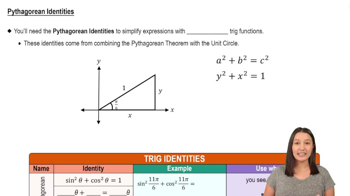
The Pythagorean identity states that sin²(θ) + cos²(θ) = 1. This fundamental identity allows us to express one trigonometric function in terms of the other, facilitating simplification of expressions that involve squares of sine and cosine functions.
Simplifying trigonometric expressions involves rewriting them to eliminate quotients and express all functions in terms of sine and cosine. This process often utilizes identities and algebraic manipulation, making it essential for solving problems that require a clear and concise form of trigonometric functions.