Graph each function over a two-period interval. See Example 4. y = -1 - 2 cos 5x
Verified step by step guidance
1
Identify the basic form of the cosine function: The given function is of the form \( y = a + b \cos(cx) \), where \( a = -1 \), \( b = -2 \), and \( c = 5 \).
Determine the amplitude: The amplitude is the absolute value of \( b \), which is \( |b| = 2 \).
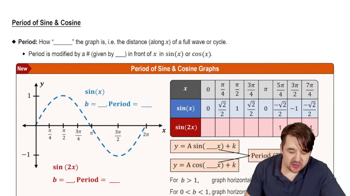
Find the period of the function: The period of a cosine function is given by \( \frac{2\pi}{c} \). For this function, the period is \( \frac{2\pi}{5} \).
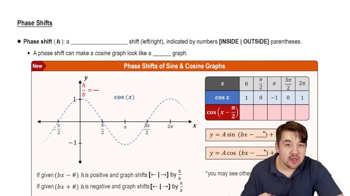
Calculate the phase shift and vertical shift: There is no phase shift since there is no horizontal translation term. The vertical shift is \( a = -1 \).
Graph the function over two periods: Start by plotting the key points of one period, then repeat the pattern for a second period. Consider the amplitude, period, and vertical shift when plotting.
Verified video answer for a similar problem:
This video solution was recommended by our tutors as helpful for the problem above
Play a video:
Was this helpful?
Key Concepts
Here are the essential concepts you must grasp in order to answer the question correctly.
Cosine Function
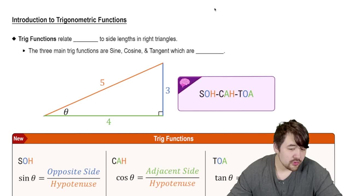
The cosine function is a fundamental trigonometric function defined as the ratio of the adjacent side to the hypotenuse in a right triangle. It is periodic, with a standard period of 2π, meaning it repeats its values every 2π units. Understanding the properties of the cosine function, including its amplitude, period, and phase shift, is essential for graphing transformations of the function.
Transformations of functions involve shifting, stretching, compressing, or reflecting the graph of a function. In the given function y = -1 - 2 cos 5x, the '-1' indicates a vertical shift downward, while the '-2' represents a vertical stretch and reflection. The '5' affects the period of the cosine function, compressing it to 2π/5. Understanding these transformations is crucial for accurately graphing the function.
Graphing trigonometric functions requires plotting key points based on the function's properties, such as amplitude, period, and phase shift. For y = -1 - 2 cos 5x, one must identify the maximum and minimum values, which are influenced by the amplitude and vertical shift. Additionally, knowing how to determine the x-intercepts and the behavior of the function over its period is vital for creating an accurate graph.