Write each function value in terms of the cofunction of a complementary angle. sin 142° 14'
Verified step by step guidance
1
Recall the cofunction identity for sine and cosine: \(\sin(\theta) = \cos(90^\circ - \theta)\), where the angles are complementary (sum to \(90^\circ\)).
Identify the given angle: \(142^\circ 14'\) is greater than \(90^\circ\), so it is not directly complementary to an angle between \(0^\circ\) and \(90^\circ\).
Use the periodicity and symmetry of sine to rewrite \(\sin 142^\circ 14'\) in terms of an angle between \(0^\circ\) and \(90^\circ\). For example, use the identity \(\sin(180^\circ - \alpha) = \sin \alpha\) to find an acute angle complementary to another angle.
Calculate the reference angle: \(180^\circ - 142^\circ 14' = 37^\circ 46'\). So, \(\sin 142^\circ 14' = \sin 37^\circ 46'\).
Now express \(\sin 37^\circ 46'\) as the cosine of its complementary angle: \(\sin 37^\circ 46' = \cos(90^\circ - 37^\circ 46') = \cos 52^\circ 14'\).
Verified video answer for a similar problem:
This video solution was recommended by our tutors as helpful for the problem above
Play a video:
0 Comments
Key Concepts
Here are the essential concepts you must grasp in order to answer the question correctly.
Cofunction Identity
Cofunction identities relate trigonometric functions of complementary angles, where the sum of the angles is 90°. For example, sin(θ) = cos(90° - θ). This allows expressing one function in terms of the cofunction of its complementary angle.
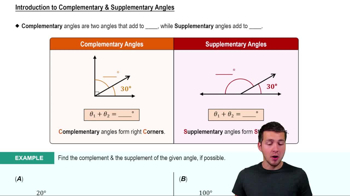
Complementary angles are two angles whose measures add up to 90°. Understanding this is essential because cofunction identities depend on the relationship between an angle and its complement.
Angles can be expressed in degrees and minutes, where 1 degree = 60 minutes. Properly interpreting and converting these units is important for accurate calculation and application of trigonometric identities.

 Verified step by step guidance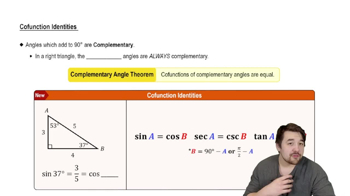
 6:30
6:30