Solve each quadratic equation using the square root property. See Example 6. x² = 16
Verified step by step guidance
1
Identify the given quadratic equation: \(x^{2} = 16\).
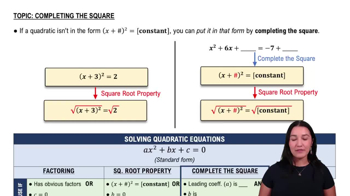
Recall the square root property, which states that if \(x^{2} = k\), then \(x = \pm \sqrt{k}\).
Apply the square root property to the equation: \(x = \pm \sqrt{16}\).
Simplify the square root: \(x = \pm 4\).
Write the final solution as two values: \(x = 4\) and \(x = -4\).
Verified video answer for a similar problem:
This video solution was recommended by our tutors as helpful for the problem above
Video duration:
1m
Play a video:
0 Comments
Key Concepts
Here are the essential concepts you must grasp in order to answer the question correctly.
Square Root Property
The square root property states that if x² = k, then x = ±√k. This means to solve an equation where a variable is squared and set equal to a number, you take the square root of both sides, considering both positive and negative roots.
Quadratic equations are polynomial equations of degree two, often written as ax² + bx + c = 0. When the equation is in the form x² = k, it can be solved directly using the square root property without factoring or using the quadratic formula.
Solving Quadratic Equations by Completing the Square
Simplifying Square Roots
When taking the square root of a number, it is important to simplify the radical if possible. For example, √16 simplifies to 4. Simplifying helps in finding exact solutions and understanding the nature of the roots.

 1:30 minutes
 Verified step by step guidance
 2:20
2:20