Ch. 5 - Trigonometric Identities
Lial - Trigonometry 12th Edition
Lial12th EditionTrigonometryISBN: 9780136552161Not the one you use?Change textbook
Chapter 6, Problem 16

Perform each indicated operation and simplify the result so that there are no quotients.
cos x/sec x + sin x/csc x

Verified step by step guidance
1
Recall the definitions of the reciprocal trigonometric functions: \(\sec x = \frac{1}{\cos x}\) and \(\csc x = \frac{1}{\sin x}\).
Rewrite each quotient using these definitions: \(\frac{\cos x}{\sec x} = \cos x \times \cos x\) and \(\frac{\sin x}{\csc x} = \sin x \times \sin x\).
Simplify the expressions by multiplying: \(\cos x \times \cos x = \cos^{2} x\) and \(\sin x \times \sin x = \sin^{2} x\).
Add the two simplified terms together: \(\cos^{2} x + \sin^{2} x\).
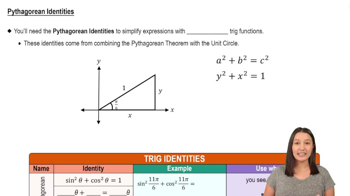
Use the Pythagorean identity \(\sin^{2} x + \cos^{2} x = 1\) to simplify the expression to its simplest form.

Verified video answer for a similar problem:

This video solution was recommended by our tutors as helpful for the problem above.
Was this helpful?

Key Concepts

Here are the essential concepts you must grasp in order to answer the question correctly.

Reciprocal Identities

Reciprocal identities relate trigonometric functions to their reciprocals, such as sec x = 1/cos x and csc x = 1/sin x. Understanding these allows you to rewrite expressions like cos x/sec x and sin x/csc x without fractions.
Recommended video:
6:25
Pythagorean Identities

Simplifying Trigonometric Expressions

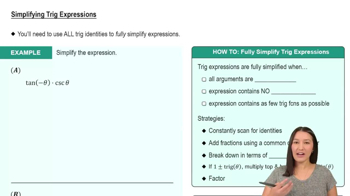
Simplifying trigonometric expressions involves combining terms, eliminating complex fractions, and rewriting functions in simpler forms. This process often uses algebraic manipulation and identities to express the result without quotients.
Recommended video:
6:36
Simplifying Trig Expressions

Basic Trigonometric Functions

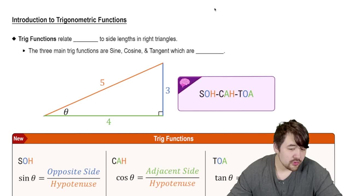
Familiarity with sine, cosine, secant, and cosecant functions and their properties is essential. Knowing their definitions and relationships helps in transforming and simplifying expressions involving these functions.
Recommended video:
6:04
Introduction to Trigonometric Functions