Find the degree measure of θ if it exists. Do not use a calculator. θ = csc⁻¹ (-2)
Verified step by step guidance
1
Understand that \( \theta = \csc^{-1}(-2) \) means \( \csc(\theta) = -2 \).
Recall that \( \csc(\theta) = \frac{1}{\sin(\theta)} \), so \( \sin(\theta) = -\frac{1}{2} \).
Identify the reference angle where \( \sin(\theta) = \frac{1}{2} \), which is \( 30^\circ \) or \( \frac{\pi}{6} \) radians.
Determine the quadrants where sine is negative, which are the third and fourth quadrants.
Find the angles in these quadrants: \( 180^\circ + 30^\circ = 210^\circ \) and \( 360^\circ - 30^\circ = 330^\circ \).
Verified video answer for a similar problem:
This video solution was recommended by our tutors as helpful for the problem above
Play a video:
Was this helpful?
Key Concepts
Here are the essential concepts you must grasp in order to answer the question correctly.
Cosecant Function
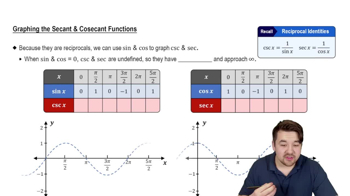
The cosecant function, denoted as csc(θ), is the reciprocal of the sine function. It is defined as csc(θ) = 1/sin(θ). The cosecant function is only defined for angles where the sine is not zero, and it takes on values from negative infinity to -1 and from 1 to positive infinity, excluding the interval (-1, 1).
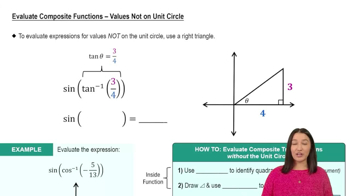
Inverse trigonometric functions, such as csc⁻¹(x), are used to find the angle whose cosecant is x. The range of the cosecant inverse function is restricted to ensure it is a function, typically between -π/2 and π/2, excluding 0. This means that when solving for θ in csc⁻¹(-2), we are looking for an angle in this range where the cosecant equals -2.
Understanding the unit circle and the corresponding angle values in different quadrants is crucial in trigonometry. The sine function is negative in the third and fourth quadrants, which means that for csc⁻¹(-2), the angle θ must be located in one of these quadrants. This knowledge helps in determining the correct angle that satisfies the given cosecant value.