Find the degree measure of θ if it exists. Do not use a calculator. θ = sin⁻¹ 2
Verified step by step guidance
1
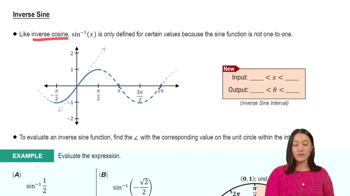
Understand that \( \sin^{-1} \) or \( \arcsin \) is the inverse sine function, which gives the angle whose sine is a given number.
Recognize that the range of the \( \sin^{-1} \) function is \([-\frac{\pi}{2}, \frac{\pi}{2}]\) or \([-90^\circ, 90^\circ]\).
Recall that the sine of an angle can only be between -1 and 1, inclusive.
Since 2 is outside the range of the sine function, there is no angle \( \theta \) such that \( \sin(\theta) = 2 \).
Conclude that \( \theta = \sin^{-1}(2) \) does not exist because 2 is not within the valid range for the sine function.
Verified video answer for a similar problem:
This video solution was recommended by our tutors as helpful for the problem above
Play a video:
Was this helpful?
Key Concepts
Here are the essential concepts you must grasp in order to answer the question correctly.
Inverse Sine Function
The inverse sine function, denoted as sin⁻¹ or arcsin, is used to find an angle whose sine value is a given number. The output of this function is restricted to the range of -90° to 90° (or -π/2 to π/2 radians), which means it can only return angles for sine values between -1 and 1. If the input exceeds this range, the function does not yield a valid angle.
The sine function outputs values between -1 and 1 for all real numbers. This means that for any angle θ, sin(θ) will always fall within this interval. Therefore, when evaluating sin⁻¹, the input must also lie within this range; otherwise, the function is undefined, indicating that no angle corresponds to the given sine value.
In trigonometry, certain values can lead to undefined results. For instance, when attempting to find the angle θ such that sin(θ) = 2, this is impossible since 2 is outside the range of the sine function. Recognizing when a value is undefined is crucial for solving trigonometric equations and understanding the limitations of trigonometric functions.