Solve each equation for exact solutions. arcsin 2x + arccos x = π/6
Verified step by step guidance
1
Identify the domain of the functions involved. Recall that the domain of arcsin(u) is -1 ≤ u ≤ 1 and for arccos(u) is -1 ≤ u ≤ 1. Therefore, ensure that 2x and x fall within these ranges.
Rewrite the equation in terms of a single trigonometric function. You can use the identity sin(θ) = cos(π/2 - θ) to express arccos(x) as π/2 - arcsin(x).
Substitute arccos(x) in the original equation: arcsin(2x) + π/2 - arcsin(x) = π/6.
Simplify the equation to isolate terms involving arcsin. This can be done by subtracting π/2 from both sides and then simplifying further.
Solve the resulting equation for x. This might involve using trigonometric identities or inverse trigonometric properties to find the values of x that satisfy the equation within the defined domain.
Was this helpful?
Key Concepts
Here are the essential concepts you must grasp in order to answer the question correctly.
Inverse Trigonometric Functions
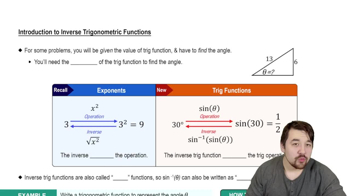
Inverse trigonometric functions, such as arcsin and arccos, are used to find angles when given the value of a trigonometric function. For example, arcsin(y) gives the angle whose sine is y, while arccos(y) gives the angle whose cosine is y. Understanding their ranges and domains is crucial for solving equations involving these functions.
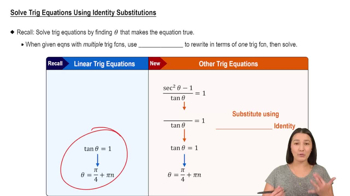
Trigonometric identities are equations that involve trigonometric functions and are true for all values of the variables involved. Key identities include the Pythagorean identity, sine and cosine relationships, and angle sum/difference identities. These identities can simplify complex equations and help in finding exact solutions.
Solving trigonometric equations involves finding the values of the variable that satisfy the equation. This often requires isolating the trigonometric function and using inverse functions or identities to find solutions. It is important to consider the periodic nature of trigonometric functions, which can lead to multiple solutions within a given interval.