Identify the reference angle where \( \tan(\theta) = \sqrt{3} \). This occurs at \( \theta = 60^\circ \) or \( \theta = \frac{\pi}{3} \) radians.
Since the tangent function is negative in the second and fourth quadrants, determine the angles in these quadrants that correspond to \( \tan(\theta) = -\sqrt{3} \).
Conclude that the possible degree measures for \( \theta \) are \( 120^\circ \) and \( 300^\circ \).
Verified video answer for a similar problem:
This video solution was recommended by our tutors as helpful for the problem above
Play a video:
Was this helpful?
Key Concepts
Here are the essential concepts you must grasp in order to answer the question correctly.
Inverse Trigonometric Functions
Inverse trigonometric functions, such as cotangent inverse (cot⁻¹), are used to find angles when given a trigonometric ratio. For example, cot⁻¹(x) gives the angle whose cotangent is x. Understanding how to interpret these functions is crucial for solving problems involving angle measures.
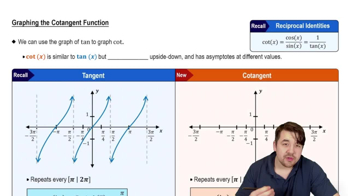
The cotangent function is defined as the ratio of the adjacent side to the opposite side in a right triangle, or as the reciprocal of the tangent function. Specifically, cot(θ) = 1/tan(θ). Knowing the values of cotangent for common angles helps in determining the angle θ when given a specific cotangent value.
Reference angles are the acute angles formed by the terminal side of an angle and the x-axis. They help in determining the actual angle in different quadrants. Since cotangent is negative in the second and fourth quadrants, understanding how to find the correct angle based on the given cotangent value is essential for solving the problem.