Textbook Question
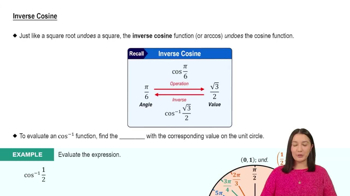
Find the exact value of each expression. cos⁻¹ (-√2/2)
786
views

 Blitzer 3rd EditionCh. 2 - Graphs of the Trigonometric Functions; Inverse Trigonometric FunctionsProblem 7
 Verified step by step guidance
 4:49
4:49
 6:04
6:04 4:22
4:22Find the exact value of each expression. cos⁻¹ (-√2/2)
Solve the right triangle shown in the figure. Round lengths to two decimal places and express angles to the nearest tenth of a degree. a = 30.4, c = 50.2
Solve the right triangle shown in the figure. Round lengths to two decimal places and express angles to the nearest tenth of a degree. a = 10.8, b = 24.7
Solve the right triangle shown in the figure. Round lengths to two decimal places and express angles to the nearest tenth of a degree. B = 16.8°, b = 30.5
Determine the amplitude, period, and phase shift of each function. Then graph one period of the function. y = −3 cos (x + π)
Find the exact value of each expression. sin⁻¹ (- 1/2)