
Determine the level of measurement of the data listed on the horizontal and vertical axes in the figure.
Table of contents
- 1. Intro to Stats and Collecting Data1h 14m
- 2. Describing Data with Tables and Graphs1h 55m
- 3. Describing Data Numerically2h 5m
- 4. Probability2h 16m
- 5. Binomial Distribution & Discrete Random Variables3h 6m
- 6. Normal Distribution and Continuous Random Variables2h 11m
- 7. Sampling Distributions & Confidence Intervals: Mean3h 23m
- Sampling Distribution of the Sample Mean and Central Limit Theorem19m
- Distribution of Sample Mean - Excel23m
- Introduction to Confidence Intervals15m
- Confidence Intervals for Population Mean1h 18m
- Determining the Minimum Sample Size Required12m
- Finding Probabilities and T Critical Values - Excel28m
- Confidence Intervals for Population Means - Excel25m
- 8. Sampling Distributions & Confidence Intervals: Proportion1h 25m
- 9. Hypothesis Testing for One Sample3h 29m
- 10. Hypothesis Testing for Two Samples4h 50m
- Two Proportions1h 13m
- Two Proportions Hypothesis Test - Excel28m
- Two Means - Unknown, Unequal Variance1h 3m
- Two Means - Unknown Variances Hypothesis Test - Excel12m
- Two Means - Unknown, Equal Variance15m
- Two Means - Unknown, Equal Variances Hypothesis Test - Excel9m
- Two Means - Known Variance12m
- Two Means - Sigma Known Hypothesis Test - Excel21m
- Two Means - Matched Pairs (Dependent Samples)42m
- Matched Pairs Hypothesis Test - Excel12m
- 11. Correlation1h 24m
- 12. Regression1h 50m
- 13. Chi-Square Tests & Goodness of Fit2h 21m
- 14. ANOVA1h 57m
1. Intro to Stats and Collecting Data
Intro to Stats
Problem 1.r.24
Textbook Question
Identify the sampling technique used, and discuss potential sources of bias (if any). Explain.
A student asks 18 friends to participate in a psychology experiment.
Verified step by step guidance1
Identify the sampling technique: The student is selecting participants based on convenience, as they are asking their friends. This is an example of a convenience sampling technique.
Explain convenience sampling: Convenience sampling involves selecting individuals who are easiest to reach or readily available. It is not random and does not ensure that every individual in the population has an equal chance of being selected.
Discuss potential sources of bias: Since the sample consists only of the student’s friends, it is not representative of the broader population. This introduces selection bias, as the sample may share similar characteristics (e.g., age, interests, or social background) that do not reflect the diversity of the entire population.
Explain the impact of bias: The lack of representativeness can lead to results that are not generalizable to the entire population. For example, conclusions drawn from this experiment may only apply to the student’s social circle and not to other groups.
Suggest improvements: To reduce bias, the student could use a random sampling technique, such as simple random sampling, where participants are chosen randomly from the entire population of interest. This would increase the likelihood of obtaining a representative sample.
Verified video answer for a similar problem:This video solution was recommended by our tutors as helpful for the problem above
Video duration:
2mPlay a video:
Was this helpful?
Key Concepts
Here are the essential concepts you must grasp in order to answer the question correctly.
Sampling Technique
Sampling technique refers to the method used to select individuals from a population to participate in a study. In this case, the student is using a non-probability sampling technique known as convenience sampling, as they are selecting friends who are readily available rather than randomly selecting from the entire population.
Recommended video:
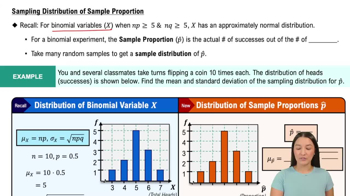
Sampling Distribution of Sample Proportion
Bias in Sampling
Bias in sampling occurs when certain members of a population are systematically more likely to be selected than others, leading to results that may not be representative. In this scenario, the potential bias arises from the fact that the sample consists only of friends, which may not reflect the broader population's diversity in terms of demographics, opinions, or behaviors.
Recommended video:
Sampling Distribution of Sample Proportion
Generalizability
Generalizability refers to the extent to which findings from a sample can be applied to the larger population. Due to the convenience sampling method and potential biases, the results of the psychology experiment may lack generalizability, making it difficult to draw conclusions that apply to individuals outside of the student's friend group.
Watch next
Master Introduction to Statistics Channel with a bite sized video explanation from Patrick
Start learningRelated Videos
Related Practice
Textbook Question
122
views
