Committee A committee consisting of four women and three men will randomly select two people to attend a conference in Hawaii. Find the probability that both are women.
Table of contents
- 1. Intro to Stats and Collecting Data1h 14m
- 2. Describing Data with Tables and Graphs1h 55m
- 3. Describing Data Numerically2h 5m
- 4. Probability2h 16m
- 5. Binomial Distribution & Discrete Random Variables3h 6m
- 6. Normal Distribution and Continuous Random Variables2h 11m
- 7. Sampling Distributions & Confidence Intervals: Mean3h 23m
- Sampling Distribution of the Sample Mean and Central Limit Theorem19m
- Distribution of Sample Mean - Excel23m
- Introduction to Confidence Intervals15m
- Confidence Intervals for Population Mean1h 18m
- Determining the Minimum Sample Size Required12m
- Finding Probabilities and T Critical Values - Excel28m
- Confidence Intervals for Population Means - Excel25m
- 8. Sampling Distributions & Confidence Intervals: Proportion2h 10m
- 9. Hypothesis Testing for One Sample5h 6m
- Steps in Hypothesis Testing1h 6m
- Performing Hypothesis Tests: Means1h 4m
- Hypothesis Testing: Means - Excel42m
- Performing Hypothesis Tests: Proportions37m
- Hypothesis Testing: Proportions - Excel27m
- Performing Hypothesis Tests: Variance12m
- Critical Values and Rejection Regions28m
- Link Between Confidence Intervals and Hypothesis Testing12m
- Type I & Type II Errors15m
- 10. Hypothesis Testing for Two Samples4h 50m
- Two Proportions1h 13m
- Two Proportions Hypothesis Test - Excel28m
- Two Means - Unknown, Unequal Variance1h 3m
- Two Means - Unknown Variances Hypothesis Test - Excel12m
- Two Means - Unknown, Equal Variance15m
- Two Means - Unknown, Equal Variances Hypothesis Test - Excel9m
- Two Means - Known Variance12m
- Two Means - Sigma Known Hypothesis Test - Excel21m
- Two Means - Matched Pairs (Dependent Samples)42m
- Matched Pairs Hypothesis Test - Excel12m
- 11. Correlation1h 24m
- 12. Regression3h 33m
- Linear Regression & Least Squares Method26m
- Residuals12m
- Coefficient of Determination12m
- Regression Line Equation and Coefficient of Determination - Excel8m
- Finding Residuals and Creating Residual Plots - Excel11m
- Inferences for Slope31m
- Enabling Data Analysis Toolpak1m
- Regression Readout of the Data Analysis Toolpak - Excel21m
- Prediction Intervals13m
- Prediction Intervals - Excel19m
- Multiple Regression - Excel29m
- Quadratic Regression15m
- Quadratic Regression - Excel10m
- 13. Chi-Square Tests & Goodness of Fit2h 21m
- 14. ANOVA1h 57m
5. Binomial Distribution & Discrete Random Variables
Hypergeometric Distribution
Problem 5.R.20
Textbook Question
Drawing Cards Suppose that you draw 3 cards without replacement from a standard 52-card deck. What is the probability that all 3 cards are aces?
Verified step by step guidance1
Identify the total number of cards in the deck, which is 52, and the total number of aces, which is 4.
Since the cards are drawn without replacement, the probability of drawing an ace on the first draw is the number of aces divided by the total number of cards: \(\frac{4}{52}\).
For the second draw, one ace and one card have been removed, so the probability of drawing an ace now is \(\frac{3}{51}\).
For the third draw, two aces and two cards have been removed, so the probability of drawing an ace now is \(\frac{2}{50}\).
Multiply these probabilities together to find the overall probability that all three cards drawn are aces: \(\frac{4}{52} \times \frac{3}{51} \times \frac{2}{50}\).
Verified video answer for a similar problem:This video solution was recommended by our tutors as helpful for the problem above
Video duration:
4mPlay a video:
Was this helpful?
Key Concepts
Here are the essential concepts you must grasp in order to answer the question correctly.
Probability Without Replacement
When drawing cards without replacement, each draw affects the next because the total number of cards decreases. This changes the probabilities for subsequent draws, making events dependent rather than independent.
Recommended video:
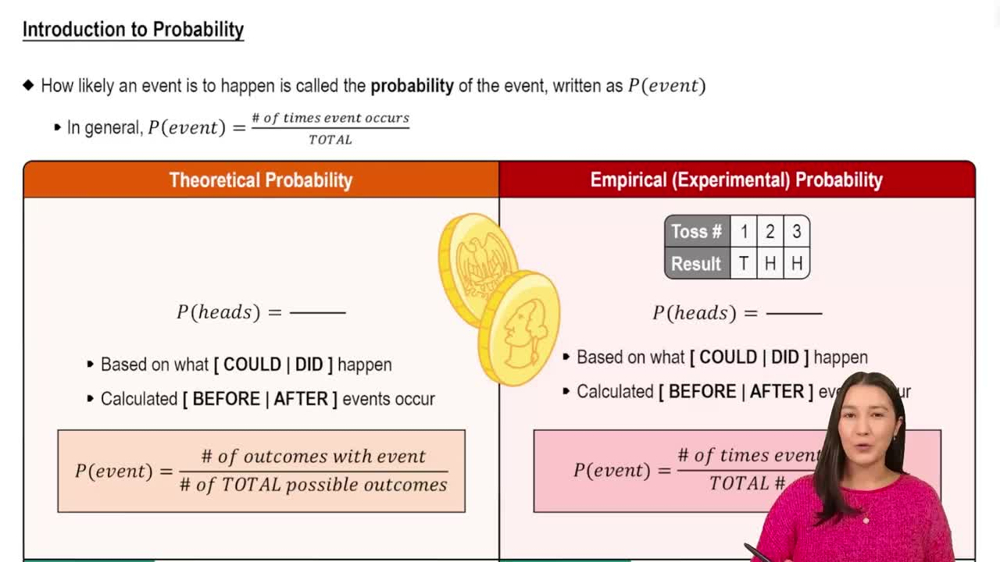
Introduction to Probability
Counting Favorable Outcomes
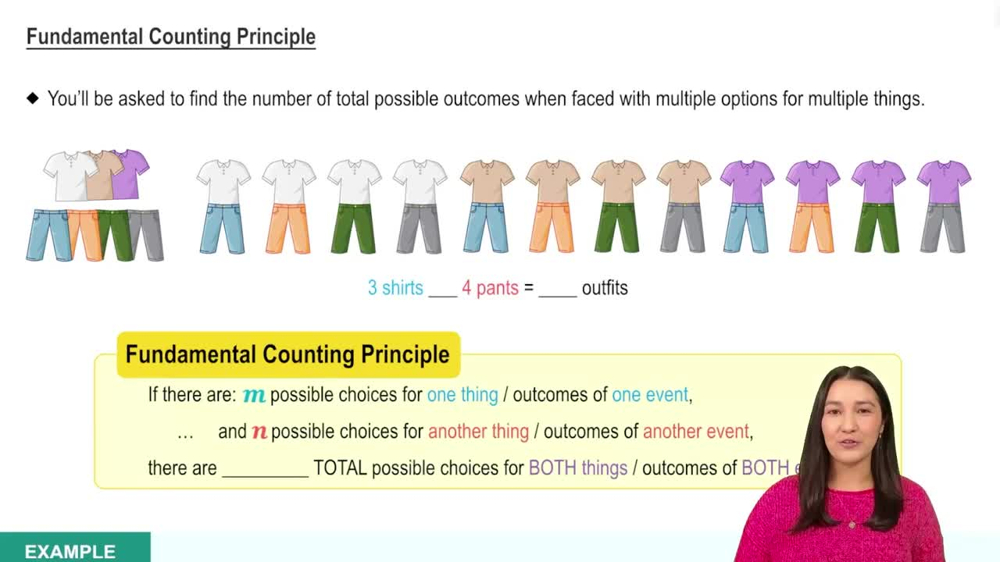
To find the probability of drawing all aces, identify the number of favorable outcomes (drawing 3 aces) and compare it to the total possible outcomes. This involves understanding how many aces remain at each draw.
Recommended video:
Fundamental Counting Principle
Multiplication Rule for Dependent Events
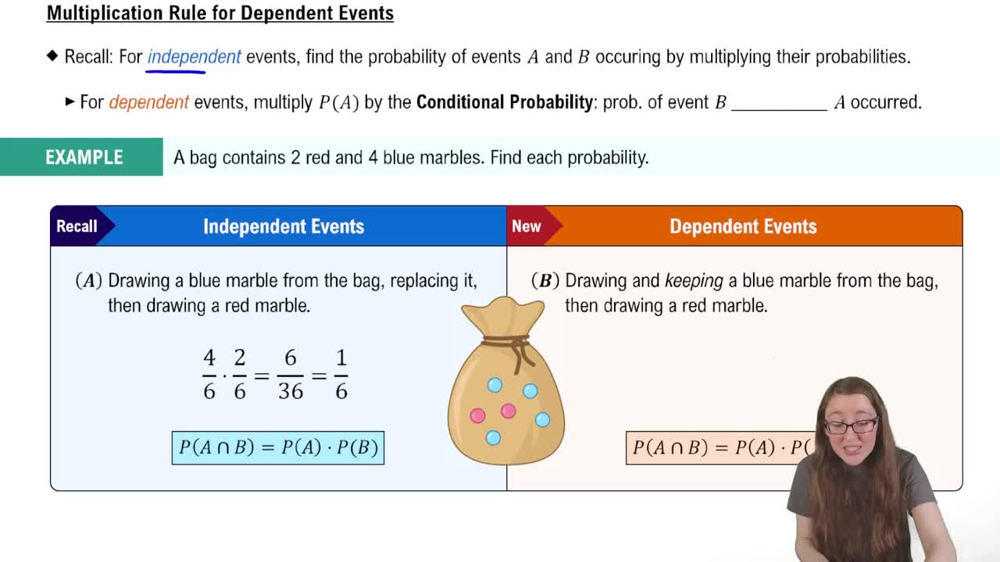
The probability of multiple dependent events occurring together is found by multiplying the probability of each event, adjusting for previous outcomes. For drawing aces, multiply the probability of each ace drawn sequentially.
Recommended video:
Multiplication Rule: Dependent Events
Watch next
Master Introduction to the Hypergeometric Distribution with a bite sized video explanation from Patrick
Start learningRelated Videos
Related Practice
Textbook Question
6
views