Soccer? In a survey of 500 randomly selected Americans, it was determined that 22 play soccer. What is the probability that a randomly selected American plays soccer?
Table of contents
- 1. Intro to Stats and Collecting Data1h 14m
- 2. Describing Data with Tables and Graphs1h 55m
- 3. Describing Data Numerically2h 5m
- 4. Probability2h 16m
- 5. Binomial Distribution & Discrete Random Variables3h 6m
- 6. Normal Distribution and Continuous Random Variables2h 11m
- 7. Sampling Distributions & Confidence Intervals: Mean3h 23m
- Sampling Distribution of the Sample Mean and Central Limit Theorem19m
- Distribution of Sample Mean - Excel23m
- Introduction to Confidence Intervals15m
- Confidence Intervals for Population Mean1h 18m
- Determining the Minimum Sample Size Required12m
- Finding Probabilities and T Critical Values - Excel28m
- Confidence Intervals for Population Means - Excel25m
- 8. Sampling Distributions & Confidence Intervals: Proportion1h 25m
- 9. Hypothesis Testing for One Sample3h 29m
- 10. Hypothesis Testing for Two Samples4h 50m
- Two Proportions1h 13m
- Two Proportions Hypothesis Test - Excel28m
- Two Means - Unknown, Unequal Variance1h 3m
- Two Means - Unknown Variances Hypothesis Test - Excel12m
- Two Means - Unknown, Equal Variance15m
- Two Means - Unknown, Equal Variances Hypothesis Test - Excel9m
- Two Means - Known Variance12m
- Two Means - Sigma Known Hypothesis Test - Excel21m
- Two Means - Matched Pairs (Dependent Samples)42m
- Matched Pairs Hypothesis Test - Excel12m
- 11. Correlation1h 24m
- 12. Regression1h 50m
- 13. Chi-Square Tests & Goodness of Fit2h 21m
- 14. ANOVA1h 57m
4. Probability
Basic Concepts of Probability
Problem 5.1.43d
Textbook Question
"[NW] Going to Disney World John, Roberto, Clarice, Dominique, and Marco work for a publishing company. The company wants to send two employees to a statistics conference in Orlando. To be fair, the company decides that the two individuals who get to attend will have their names randomly drawn from a hat.
d. What is the probability that John stays home?"
Verified step by step guidance1
Identify the total number of employees eligible for selection. In this case, there are 5 employees: John, Roberto, Clarice, Dominique, and Marco.
Determine the total number of ways to choose 2 employees out of 5. This is a combination problem, so use the formula for combinations: \(C(n, k) = \frac{n!}{k!(n-k)!}\), where \(n=5\) and \(k=2\).
Calculate the total number of possible pairs that can be drawn from the 5 employees using the combination formula: \(C(5, 2)\).
Next, find the number of favorable outcomes where John is NOT selected. This means both selected employees come from the other 4 employees (Roberto, Clarice, Dominique, and Marco). Calculate the number of ways to choose 2 employees from these 4 using \(C(4, 2)\).
Finally, compute the probability that John stays home by dividing the number of favorable outcomes (John not selected) by the total number of possible outcomes (any 2 employees selected): \(P(\text{John stays home}) = \frac{C(4, 2)}{C(5, 2)}\).
Verified video answer for a similar problem:This video solution was recommended by our tutors as helpful for the problem above
Video duration:
1mPlay a video:
Was this helpful?
Key Concepts
Here are the essential concepts you must grasp in order to answer the question correctly.
Sample Space
The sample space is the set of all possible outcomes in a probability experiment. In this case, it includes all possible pairs of employees that can be chosen to attend the conference. Understanding the sample space helps determine the total number of equally likely outcomes.
Recommended video:
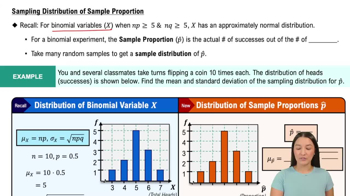
Sampling Distribution of Sample Proportion
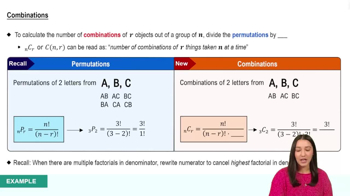
Combinations
Combinations refer to the selection of items where order does not matter. Since the company is choosing 2 employees out of 5 without regard to order, the number of possible pairs is calculated using combinations, specifically "5 choose 2".
Recommended video:
Combinations
Complement Rule
The complement rule states that the probability of an event not happening is one minus the probability that it does happen. To find the probability that John stays home, we can find the probability that John is chosen and subtract it from 1.
Recommended video:
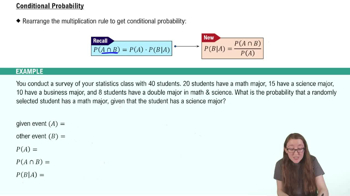
Conditional Probability Rule
Watch next
Master Introduction to Probability with a bite sized video explanation from Patrick
Start learningRelated Videos
Related Practice
Textbook Question
14
views