Credit ScoresA Fair Isaac Corporation (FICO) score is used by credit agencies (such as mortgage companies and banks) to assess the creditworthiness of individuals. Values range from 300 to 850, with a FICO score over 700 considered to be a quality credit risk. According to Fair Isaac Corporation, the mean FICO score is 703.5. A credit analyst wondered whether high-income individuals (incomes in excess of \$100,000 per year) had higher credit scores. He obtained a random sample of 40 high-income individuals and found the sample mean credit score to be 714.2 with a standard deviation of 83.2. Conduct the appropriate test to determine if high-income individuals have higher FICO scores at the α = 0.05 level of significance.
Table of contents
- 1. Intro to Stats and Collecting Data1h 14m
- 2. Describing Data with Tables and Graphs1h 55m
- 3. Describing Data Numerically2h 5m
- 4. Probability2h 16m
- 5. Binomial Distribution & Discrete Random Variables3h 6m
- 6. Normal Distribution and Continuous Random Variables2h 11m
- 7. Sampling Distributions & Confidence Intervals: Mean3h 23m
- Sampling Distribution of the Sample Mean and Central Limit Theorem19m
- Distribution of Sample Mean - Excel23m
- Introduction to Confidence Intervals15m
- Confidence Intervals for Population Mean1h 18m
- Determining the Minimum Sample Size Required12m
- Finding Probabilities and T Critical Values - Excel28m
- Confidence Intervals for Population Means - Excel25m
- 8. Sampling Distributions & Confidence Intervals: Proportion1h 25m
- 9. Hypothesis Testing for One Sample3h 29m
- 10. Hypothesis Testing for Two Samples4h 50m
- Two Proportions1h 13m
- Two Proportions Hypothesis Test - Excel28m
- Two Means - Unknown, Unequal Variance1h 3m
- Two Means - Unknown Variances Hypothesis Test - Excel12m
- Two Means - Unknown, Equal Variance15m
- Two Means - Unknown, Equal Variances Hypothesis Test - Excel9m
- Two Means - Known Variance12m
- Two Means - Sigma Known Hypothesis Test - Excel21m
- Two Means - Matched Pairs (Dependent Samples)42m
- Matched Pairs Hypothesis Test - Excel12m
- 11. Correlation1h 24m
- 12. Regression1h 50m
- 13. Chi-Square Tests & Goodness of Fit2h 21m
- 14. ANOVA1h 57m
9. Hypothesis Testing for One Sample
Performing Hypothesis Tests: Means
Problem 10.3.14a
Textbook Question
SAT Verbal ScoresDo students who learned English and another language simultaneously score worse on the SAT Critical Reading exam than the general population of test takers? The mean score among all test takers on the SAT Critical Reading exam is 501. A random sample of 100 test takers who learned English and another language simultaneously had a mean SAT Critical Reading score of 485 with a standard deviation of 116. Do these results suggest that students who learn English as well as another language simultaneously score worse on the SAT Critical Reading exam?
a. State the appropriate null and alternative hypotheses.
Verified step by step guidance1
Identify the parameter of interest: the population mean SAT Critical Reading score for students who learned English and another language simultaneously.
State the null hypothesis (\(H_0\)) as the claim that the mean score for these students is equal to the general population mean, i.e., \(H_0: \mu = 501\).
State the alternative hypothesis (\(H_a\)) as the claim that the mean score for these students is less than the general population mean, i.e., \(H_a: \mu < 501\).
Explain that this is a one-tailed test because we are specifically testing if the mean score is lower, not just different.
Clarify that these hypotheses set the framework for conducting a hypothesis test to determine if the observed sample mean provides enough evidence to conclude that students who learned English and another language simultaneously score worse.
Verified video answer for a similar problem:This video solution was recommended by our tutors as helpful for the problem above
Video duration:
2mPlay a video:
Was this helpful?
Key Concepts
Here are the essential concepts you must grasp in order to answer the question correctly.
Hypothesis Testing
Hypothesis testing is a statistical method used to decide whether there is enough evidence to reject a presumed statement (null hypothesis) about a population parameter. It involves formulating a null hypothesis (no effect or difference) and an alternative hypothesis (presence of an effect or difference), then using sample data to assess their plausibility.
Recommended video:
Performing Hypothesis Tests: Proportions
Null and Alternative Hypotheses
The null hypothesis (H0) represents the default assumption, often stating no difference or no effect, while the alternative hypothesis (Ha) represents the claim we want to test. In this context, H0 would state that the mean SAT score of bilingual students equals the general population mean, and Ha would state it is lower.
Recommended video:
Guided course
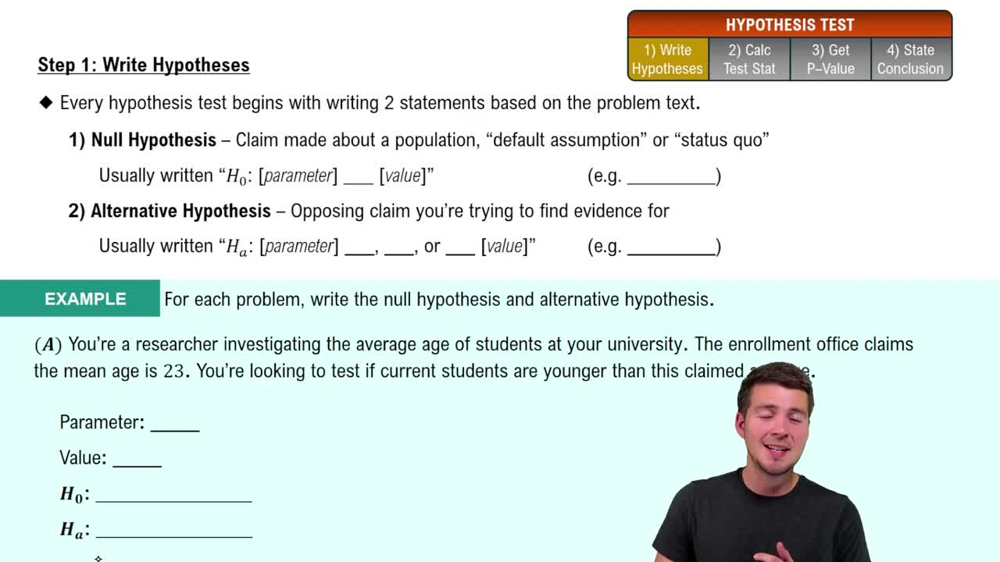
Step 1: Write Hypotheses
Sampling Distribution and Standard Error
The sampling distribution describes how sample means vary around the population mean. The standard error measures the typical distance between a sample mean and the population mean, calculated as the sample standard deviation divided by the square root of the sample size. It is crucial for determining how unusual the observed sample mean is under the null hypothesis.
Recommended video:
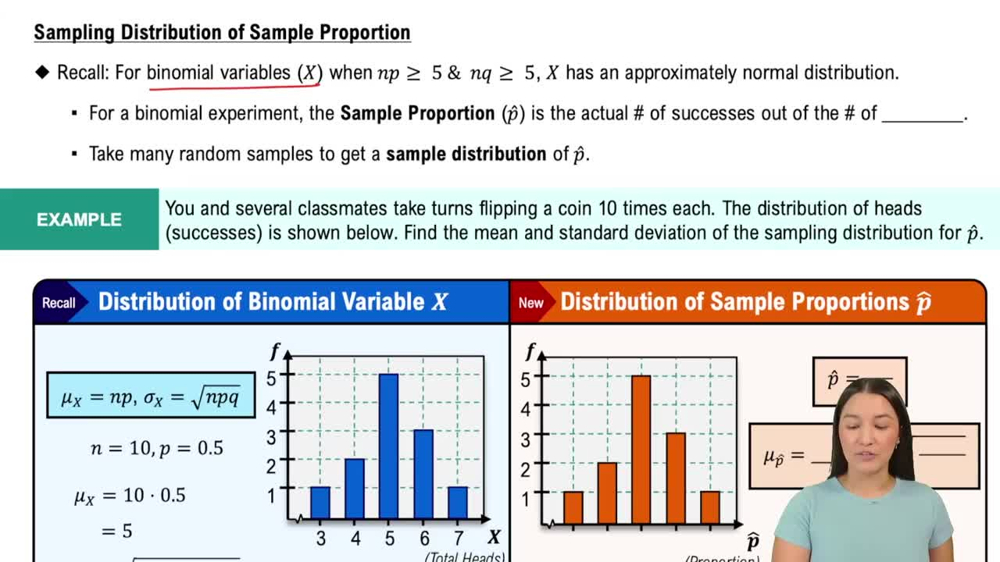
Sampling Distribution of Sample Proportion
Watch next
Master Standard Deviation (σ) Known with a bite sized video explanation from Patrick
Start learningRelated Videos
Related Practice
Textbook Question
13
views