"Interpreting the Variable Suppose a fundraiser holds a raffle for which each person who enters the room receives a ticket numbered 1 to N, where N is the number of people at the fundraiser. The first person to arrive receives ticket number 1, the second person receives ticket number 2, and so on. Determine the level of measurement for each of the following interpretations of the variable ticket number.
The winning ticket number."
Verified step by step guidance
1
Step 1: Understand the variable in question. The variable is the ticket number assigned to each person, which ranges from 1 to N, where N is the total number of people at the fundraiser.
Step 2: Recall the four levels of measurement in statistics: nominal, ordinal, interval, and ratio. Each level has specific characteristics regarding the nature of the data and the operations that can be performed.
Step 3: Analyze the winning ticket number as a variable. Since ticket numbers are assigned sequentially and uniquely, they can be ordered, but the numbers themselves represent labels rather than quantities with meaningful differences.
Step 4: Determine if the ticket number has a meaningful zero point and equal intervals. The ticket numbers start at 1, not zero, and the difference between ticket numbers does not represent a measurable quantity (e.g., ticket 5 is not 'twice' ticket 2).
Step 5: Conclude the level of measurement. Since the ticket numbers serve as unique identifiers with an inherent order but no meaningful arithmetic operations, the winning ticket number is best classified as an ordinal variable.
Verified video answer for a similar problem:
This video solution was recommended by our tutors as helpful for the problem above
Video duration:
1m
Play a video:
0 Comments
Key Concepts
Here are the essential concepts you must grasp in order to answer the question correctly.
Levels of Measurement
Levels of measurement classify data based on their attributes and the mathematical operations applicable. The four main levels are nominal, ordinal, interval, and ratio, each with increasing complexity and information. Understanding these levels helps determine how to analyze and interpret data correctly.
Difference in Proportions: Hypothesis Tests Example 1
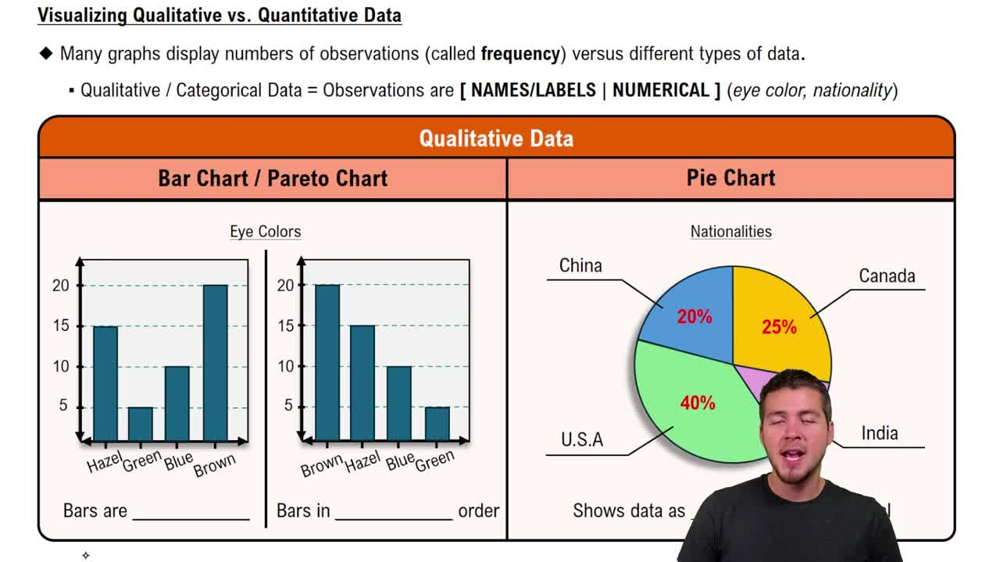
Nominal vs. Ordinal Data
Nominal data categorize without any order (e.g., colors or names), while ordinal data have a meaningful order but no consistent difference between values (e.g., rankings). Identifying whether ticket numbers represent categories or ordered positions is key to classifying the variable.
Ticket numbers can be identifiers (nominal) or indicate order (ordinal). For the winning ticket number, the number serves as a label to identify the winner, not implying order or magnitude, so it is typically considered nominal data.

 1:52 minutes
 Verified step by step guidance

 10:28
10:28