The heights (in feet) and the number of stories of the ten tallest buildings in New York City are listed. Use a scatter plot to display the data. Describe any patterns. (Source: Emporis)
Table of contents
- 1. Intro to Stats and Collecting Data1h 14m
- 2. Describing Data with Tables and Graphs1h 55m
- 3. Describing Data Numerically2h 5m
- 4. Probability2h 16m
- 5. Binomial Distribution & Discrete Random Variables3h 6m
- 6. Normal Distribution and Continuous Random Variables2h 11m
- 7. Sampling Distributions & Confidence Intervals: Mean3h 23m
- Sampling Distribution of the Sample Mean and Central Limit Theorem19m
- Distribution of Sample Mean - Excel23m
- Introduction to Confidence Intervals15m
- Confidence Intervals for Population Mean1h 18m
- Determining the Minimum Sample Size Required12m
- Finding Probabilities and T Critical Values - Excel28m
- Confidence Intervals for Population Means - Excel25m
- 8. Sampling Distributions & Confidence Intervals: Proportion1h 25m
- 9. Hypothesis Testing for One Sample3h 29m
- 10. Hypothesis Testing for Two Samples4h 50m
- Two Proportions1h 13m
- Two Proportions Hypothesis Test - Excel28m
- Two Means - Unknown, Unequal Variance1h 3m
- Two Means - Unknown Variances Hypothesis Test - Excel12m
- Two Means - Unknown, Equal Variance15m
- Two Means - Unknown, Equal Variances Hypothesis Test - Excel9m
- Two Means - Known Variance12m
- Two Means - Sigma Known Hypothesis Test - Excel21m
- Two Means - Matched Pairs (Dependent Samples)42m
- Matched Pairs Hypothesis Test - Excel12m
- 11. Correlation1h 24m
- 12. Regression1h 50m
- 13. Chi-Square Tests & Goodness of Fit2h 21m
- 14. ANOVA1h 57m
2. Describing Data with Tables and Graphs
Dot Plots
Problem 2.5.28b
Textbook Question
Hourly Earnings Refer to the data set in Exercise 26 and the box-and-whisker plot you drew that represents the data set.
b. What percent of the employees made more than \$23.39 per hour?
Verified step by step guidance1
Step 1: Recall that a box-and-whisker plot divides the data into quartiles, with the box representing the interquartile range (IQR) and the whiskers extending to the minimum and maximum values. Identify the position of \$23.39 on the plot relative to the quartiles.
Step 2: Determine which quartile \$23.39 falls into. If it is above the third quartile (Q3), then it represents the upper 25% of the data. If it is within the IQR, calculate its position relative to Q3.
Step 3: Use the cumulative percentage of the quartiles to estimate the percentage of employees earning more than \$23.39. For example, if \$23.39 is above Q3, then the percentage of employees earning more than \$23.39 is less than 25%.
Step 4: If \$23.39 is within the IQR, calculate the proportion of the data in the upper quartile that exceeds \$23.39. This can be done by determining the relative position of \$23.39 within the range of Q3 to the maximum value.
Step 5: Combine the results from the previous steps to express the percentage of employees earning more than \$23.39 as a proportion of the total data set.
Verified video answer for a similar problem:This video solution was recommended by our tutors as helpful for the problem above
Video duration:
2mPlay a video:
Was this helpful?
Key Concepts
Here are the essential concepts you must grasp in order to answer the question correctly.
Box-and-Whisker Plot
A box-and-whisker plot is a graphical representation of a data set that displays its minimum, first quartile, median, third quartile, and maximum. It helps visualize the distribution and identify outliers. The box represents the interquartile range (IQR), while the 'whiskers' extend to the smallest and largest values within 1.5 times the IQR from the quartiles.
Recommended video:
Guided course
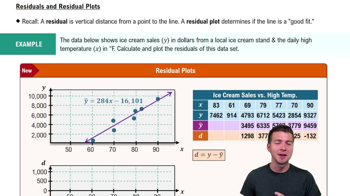
Residuals and Residual Plots
Percentile
A percentile is a measure used in statistics to indicate the value below which a given percentage of observations fall. For example, the 75th percentile means that 75% of the data points are below that value. Understanding percentiles is crucial for interpreting data distributions and determining how a specific value compares to the rest of the data set.
Calculating Percentages
Calculating percentages involves determining the proportion of a part relative to the whole, expressed as a fraction of 100. In the context of the question, to find the percentage of employees earning more than a specific hourly rate, one would count the number of employees above that rate and divide by the total number of employees, then multiply by 100 to convert it to a percentage.
Recommended video:
Guided course
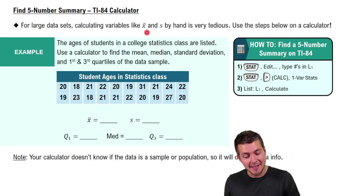
Find 5-Number Summary - TI-84 Calculator
Related Videos
Related Practice
Textbook Question
74
views