In Problems 39–42, use the given table, which lists six possible assignments of probabilities for tossing a coin twice, to answer the following questions. Which of the assignments of probabilities should be used if the coin is known to be fair?
Verified step by step guidance
1
Step 1: Understand the problem context. We are tossing a coin twice, so the sample space consists of four possible outcomes: HH, HT, TH, and TT.
Step 2: Recall that a fair coin means each outcome in the sample space should have an equal probability. Since there are 4 outcomes, each should have a probability of \(\frac{1}{4}\).
Step 3: Examine each assignment in the table to see which one assigns a probability of \(\frac{1}{4}\) to each of the four outcomes HH, HT, TH, and TT.
Step 4: Check if the probabilities in the assignment sum to 1, which is a requirement for any valid probability distribution.
Step 5: Identify the assignment where all four outcomes have equal probabilities of \(\frac{1}{4}\) and the total sums to 1. This assignment corresponds to the fair coin scenario.
Verified video answer for a similar problem:
This video solution was recommended by our tutors as helpful for the problem above
Video duration:
3m
Play a video:
0 Comments
Key Concepts
Here are the essential concepts you must grasp in order to answer the question correctly.
Sample Space and Outcomes
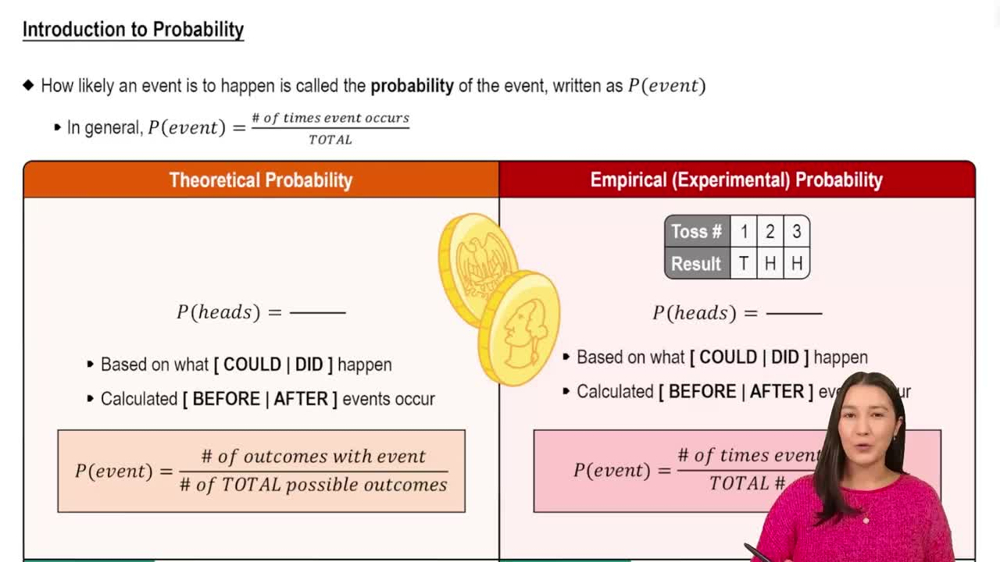
The sample space is the set of all possible outcomes of an experiment. For tossing a coin twice, the sample space includes HH, HT, TH, and TT. Understanding the sample space is essential to assign probabilities correctly to each outcome.
Probabilities must be non-negative and sum to 1 across all outcomes in the sample space. Any assignment violating these rules, such as negative probabilities or sums not equal to 1, is invalid. This ensures the probability model is consistent and meaningful.
A fair coin means each toss is unbiased, so each outcome in the sample space is equally likely. For two tosses, each of the four outcomes should have a probability of 1/4. This concept helps identify which probability assignment corresponds to a fair coin.

 3:07 minutes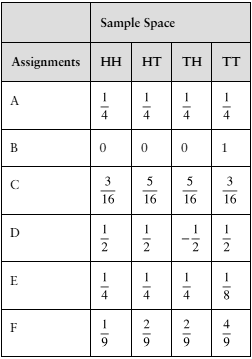
 Verified step by step guidance
 05:11
05:11