Explain the difference between a lurking variable and a confounding variable.
Table of contents
- 1. Intro to Stats and Collecting Data1h 14m
- 2. Describing Data with Tables and Graphs1h 55m
- 3. Describing Data Numerically2h 5m
- 4. Probability2h 16m
- 5. Binomial Distribution & Discrete Random Variables3h 6m
- 6. Normal Distribution and Continuous Random Variables2h 11m
- 7. Sampling Distributions & Confidence Intervals: Mean3h 23m
- Sampling Distribution of the Sample Mean and Central Limit Theorem19m
- Distribution of Sample Mean - Excel23m
- Introduction to Confidence Intervals15m
- Confidence Intervals for Population Mean1h 18m
- Determining the Minimum Sample Size Required12m
- Finding Probabilities and T Critical Values - Excel28m
- Confidence Intervals for Population Means - Excel25m
- 8. Sampling Distributions & Confidence Intervals: Proportion1h 25m
- 9. Hypothesis Testing for One Sample3h 29m
- 10. Hypothesis Testing for Two Samples4h 50m
- Two Proportions1h 13m
- Two Proportions Hypothesis Test - Excel28m
- Two Means - Unknown, Unequal Variance1h 3m
- Two Means - Unknown Variances Hypothesis Test - Excel12m
- Two Means - Unknown, Equal Variance15m
- Two Means - Unknown, Equal Variances Hypothesis Test - Excel9m
- Two Means - Known Variance12m
- Two Means - Sigma Known Hypothesis Test - Excel21m
- Two Means - Matched Pairs (Dependent Samples)42m
- Matched Pairs Hypothesis Test - Excel12m
- 11. Correlation1h 24m
- 12. Regression1h 50m
- 13. Chi-Square Tests & Goodness of Fit2h 21m
- 14. ANOVA1h 57m
1. Intro to Stats and Collecting Data
Intro to Stats
Problem 1.6.11d
Textbook Question
"Whiter Teeth An ad for Crest Whitestrips Premium claims that the strips will whiten teeth in 7 days and the results will last for 12 months. A researcher who wishes to test this claim studies 20 sets of identical twins. Within each set of twins, one is randomly selected to use Crest Whitestrips Premium in addition to regular brushing and flossing, while the other just brushes and flosses. Whiteness of teeth is measured at the beginning of the study, after 7 days, and every month thereafter for 12 months.
What are other factors (controlled or uncontrolled) that could affect the response variable?"
Verified step by step guidance1
Step 1: Identify the response variable in the study, which is the whiteness of teeth measured at different time points.
Step 2: Understand that the study uses identical twins to control for genetic factors, as twins share the same genetic makeup, reducing genetic variability in the response.
Step 3: Consider controlled factors, such as the use of Crest Whitestrips Premium versus regular brushing and flossing, and the random assignment of treatment within twin pairs to reduce bias.
Step 4: Think about uncontrolled factors that could affect teeth whiteness, such as diet (consumption of staining foods or drinks like coffee or wine), oral hygiene habits beyond brushing and flossing, exposure to other whitening products, or environmental factors like smoking.
Step 5: Also consider measurement-related factors, such as consistency in how whiteness is measured, lighting conditions, or subjective assessment differences, which could introduce variability in the response.
Verified video answer for a similar problem:This video solution was recommended by our tutors as helpful for the problem above
Video duration:
3mPlay a video:
Was this helpful?
Key Concepts
Here are the essential concepts you must grasp in order to answer the question correctly.
Controlled Variables
Controlled variables are factors that the researcher keeps constant to ensure that the effect on the response variable is due to the treatment alone. In this study, regular brushing and flossing are controlled to isolate the effect of Crest Whitestrips. Controlling variables helps reduce confounding and increases the validity of the results.
Recommended video:
Guided course
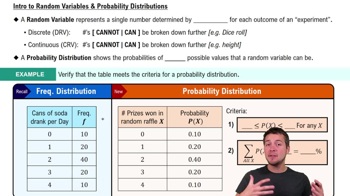
Intro to Random Variables & Probability Distributions
Confounding Variables
Confounding variables are factors other than the treatment that may influence the response variable, potentially biasing the results. Examples here could include diet, smoking habits, or natural differences in tooth enamel. Identifying and accounting for confounders is essential to accurately interpret the effect of the whitening strips.
Recommended video:
Guided course
Intro to Random Variables & Probability Distributions
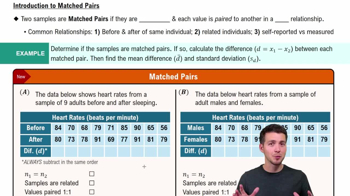
Randomization and Matched Pairs Design
Randomization assigns treatments randomly to subjects to reduce bias, while matched pairs design uses pairs (like twins) to control for genetic and environmental similarities. This design helps isolate the treatment effect by comparing outcomes within each twin pair, minimizing variability from individual differences.
Recommended video:
Guided course
Introduction to Matched Pairs
Watch next
Master Introduction to Statistics Channel with a bite sized video explanation from Patrick
Start learningRelated Videos
Related Practice
Textbook Question
17
views