
A rare condition affects 1 out of every 100 people. The test for this condition has the following probabilities: If a person has the condition, the test is correct 95% of the time. If a person does not have the condition, the test gives a wrong result 10% of the time. If A is the event 'tested positive' and B is the event 'has condition,' find P(B'), P(AIB), and P(A|B').
Table of contents
- 1. Intro to Stats and Collecting Data1h 14m
- 2. Describing Data with Tables and Graphs1h 55m
- 3. Describing Data Numerically2h 5m
- 4. Probability2h 16m
- 5. Binomial Distribution & Discrete Random Variables3h 6m
- 6. Normal Distribution and Continuous Random Variables2h 11m
- 7. Sampling Distributions & Confidence Intervals: Mean3h 23m
- Sampling Distribution of the Sample Mean and Central Limit Theorem19m
- Distribution of Sample Mean - Excel23m
- Introduction to Confidence Intervals15m
- Confidence Intervals for Population Mean1h 18m
- Determining the Minimum Sample Size Required12m
- Finding Probabilities and T Critical Values - Excel28m
- Confidence Intervals for Population Means - Excel25m
- 8. Sampling Distributions & Confidence Intervals: Proportion1h 25m
- 9. Hypothesis Testing for One Sample3h 29m
- 10. Hypothesis Testing for Two Samples4h 50m
- Two Proportions1h 13m
- Two Proportions Hypothesis Test - Excel28m
- Two Means - Unknown, Unequal Variance1h 3m
- Two Means - Unknown Variances Hypothesis Test - Excel12m
- Two Means - Unknown, Equal Variance15m
- Two Means - Unknown, Equal Variances Hypothesis Test - Excel9m
- Two Means - Known Variance12m
- Two Means - Sigma Known Hypothesis Test - Excel21m
- Two Means - Matched Pairs (Dependent Samples)42m
- Matched Pairs Hypothesis Test - Excel12m
- 11. Correlation1h 24m
- 12. Regression1h 50m
- 13. Chi-Square Tests & Goodness of Fit2h 21m
- 14. ANOVA1h 57m
4. Probability
Bayes' Theorem
Problem 3.2.38
Textbook Question
"According to Bayes’ Theorem, the probability of event A , given that event B has occurred, is
P(A|B) = P(A) * P(B|A)P(A) * P(B|A) + P(A') * P(B|A').
In Exercises 33–38, use Bayes’ Theorem to find P(A|B).
38. P(A) = 12%, P(A') = 88%, P(B|A) = 66% , and P(B|A') = 19% "
Verified step by step guidance1
Step 1: Recall Bayes' Theorem formula: P(A|B) = (P(A) * P(B|A)) / (P(A) * P(B|A) + P(A') * P(B|A')). This formula helps calculate the probability of event A occurring given that event B has occurred.
Step 2: Identify the given probabilities from the problem: P(A) = 0.12, P(A') = 0.88, P(B|A) = 0.66, and P(B|A') = 0.19.
Step 3: Substitute the given values into the numerator of the formula: P(A) * P(B|A) = 0.12 * 0.66.
Step 4: Substitute the given values into the denominator of the formula: P(A) * P(B|A) + P(A') * P(B|A') = (0.12 * 0.66) + (0.88 * 0.19).
Step 5: Divide the result of the numerator by the result of the denominator to find P(A|B). This will give you the probability of event A occurring given that event B has occurred.
Verified video answer for a similar problem:This video solution was recommended by our tutors as helpful for the problem above
Video duration:
2mPlay a video:
Was this helpful?
Key Concepts
Here are the essential concepts you must grasp in order to answer the question correctly.
Bayes' Theorem
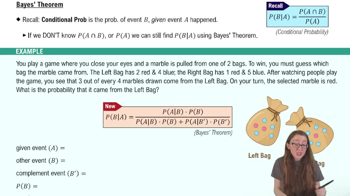
Bayes' Theorem is a fundamental principle in probability theory that describes how to update the probability of a hypothesis based on new evidence. It states that the probability of event A given event B (P(A|B)) can be calculated using the formula P(A|B) = P(A) * P(B|A) / (P(A) * P(B|A) + P(A') * P(B|A')). This theorem is particularly useful in scenarios where prior knowledge about the events is available.
Recommended video:
Bayes' Theorem
Conditional Probability
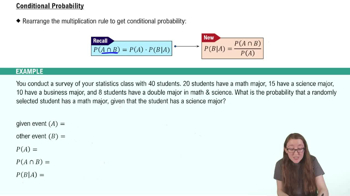
Conditional probability is the measure of the probability of an event occurring given that another event has already occurred. It is denoted as P(A|B), which represents the probability of event A occurring under the condition that event B is true. Understanding conditional probability is crucial for applying Bayes' Theorem, as it allows us to assess how the occurrence of one event influences the likelihood of another.
Recommended video:
Conditional Probability Rule
Prior and Posterior Probabilities
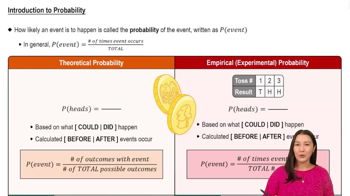
In the context of Bayes' Theorem, prior probability refers to the initial assessment of the likelihood of an event before new evidence is considered (P(A)), while posterior probability is the updated probability after taking into account the new evidence (P(A|B)). The distinction between these two types of probabilities is essential for understanding how new information can change our beliefs about the likelihood of events.
Recommended video:
Introduction to Probability
Related Videos
Related Practice
Multiple Choice
124
views
2
rank
