If the linear correlation between two variables is negative, what can be said about the slope of the regression line?
Table of contents
- 1. Intro to Stats and Collecting Data1h 14m
- 2. Describing Data with Tables and Graphs1h 55m
- 3. Describing Data Numerically2h 5m
- 4. Probability2h 16m
- 5. Binomial Distribution & Discrete Random Variables3h 6m
- 6. Normal Distribution and Continuous Random Variables2h 11m
- 7. Sampling Distributions & Confidence Intervals: Mean3h 23m
- Sampling Distribution of the Sample Mean and Central Limit Theorem19m
- Distribution of Sample Mean - Excel23m
- Introduction to Confidence Intervals15m
- Confidence Intervals for Population Mean1h 18m
- Determining the Minimum Sample Size Required12m
- Finding Probabilities and T Critical Values - Excel28m
- Confidence Intervals for Population Means - Excel25m
- 8. Sampling Distributions & Confidence Intervals: Proportion2h 10m
- 9. Hypothesis Testing for One Sample5h 6m
- Steps in Hypothesis Testing1h 6m
- Performing Hypothesis Tests: Means1h 4m
- Hypothesis Testing: Means - Excel42m
- Performing Hypothesis Tests: Proportions37m
- Hypothesis Testing: Proportions - Excel27m
- Performing Hypothesis Tests: Variance12m
- Critical Values and Rejection Regions28m
- Link Between Confidence Intervals and Hypothesis Testing12m
- Type I & Type II Errors15m
- 10. Hypothesis Testing for Two Samples4h 50m
- Two Proportions1h 13m
- Two Proportions Hypothesis Test - Excel28m
- Two Means - Unknown, Unequal Variance1h 3m
- Two Means - Unknown Variances Hypothesis Test - Excel12m
- Two Means - Unknown, Equal Variance15m
- Two Means - Unknown, Equal Variances Hypothesis Test - Excel9m
- Two Means - Known Variance12m
- Two Means - Sigma Known Hypothesis Test - Excel21m
- Two Means - Matched Pairs (Dependent Samples)42m
- Matched Pairs Hypothesis Test - Excel12m
- 11. Correlation1h 24m
- 12. Regression3h 33m
- Linear Regression & Least Squares Method26m
- Residuals12m
- Coefficient of Determination12m
- Regression Line Equation and Coefficient of Determination - Excel8m
- Finding Residuals and Creating Residual Plots - Excel11m
- Inferences for Slope31m
- Enabling Data Analysis Toolpak1m
- Regression Readout of the Data Analysis Toolpak - Excel21m
- Prediction Intervals13m
- Prediction Intervals - Excel19m
- Multiple Regression - Excel29m
- Quadratic Regression15m
- Quadratic Regression - Excel10m
- 13. Chi-Square Tests & Goodness of Fit2h 21m
- 14. ANOVA1h 57m
12. Regression
Linear Regression & Least Squares Method
Problem 4.2.14d
Textbook Question
You Explain It! Study Time and Exam Scores
After the first exam in a statistics course, Professor Katula surveyed 14 randomly selected students to determine the relation between the amount of time they spent studying for the exam and exam score. She found that a linear relation exists between the two variables. The least-squares regression line that describes this relation is:
ŷ = 6.3333x + 53.0298
d. A student who studied 5 hours for the exam scored 81 on the exam. Is this student’s exam score above or below average among all students who studied 5 hours?
Verified step by step guidance1
Identify the given regression equation: \(\hat{y} = 6.3333x + 53.0298\), where \(x\) is the number of study hours and \(\hat{y}\) is the predicted exam score.
Substitute the given study time \(x = 5\) hours into the regression equation to find the predicted (average) exam score for students who studied 5 hours: \(\hat{y} = 6.3333 \times 5 + 53.0298\).
Calculate the predicted exam score \(\hat{y}\) (do not compute the final value here, just set up the expression). This value represents the average exam score for students who studied 5 hours.
Compare the actual exam score of the student, which is 81, to the predicted average score \(\hat{y}\) for 5 hours of study.
If the actual score (81) is greater than the predicted score \(\hat{y}\), then the student's score is above average; if it is less, then the score is below average.
Verified video answer for a similar problem:This video solution was recommended by our tutors as helpful for the problem above
Video duration:
1mPlay a video:
Was this helpful?
Key Concepts
Here are the essential concepts you must grasp in order to answer the question correctly.
Least-Squares Regression Line
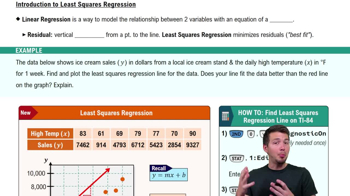
The least-squares regression line is a straight line that best fits the data points by minimizing the sum of the squared differences between observed and predicted values. It models the relationship between an independent variable (study time) and a dependent variable (exam score), allowing predictions of exam scores based on study hours.
Recommended video:
Guided course
Intro to Least Squares Regression
Predicted Value (ŷ) and Interpretation
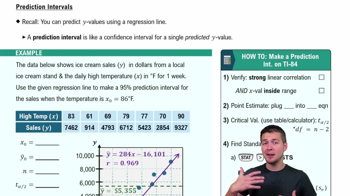
The predicted value ŷ is the exam score estimated by the regression line for a given study time x. Comparing an actual score to ŷ helps determine if the score is above or below average for that study time, indicating whether the student performed better or worse than expected.
Recommended video:
Guided course
Prediction Intervals
Residuals and Their Meaning
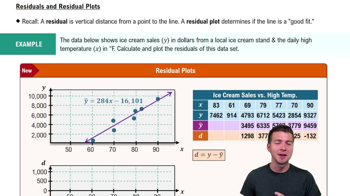
A residual is the difference between the observed exam score and the predicted score from the regression line. A positive residual means the student scored above average for their study time, while a negative residual indicates a below-average score, helping assess individual performance relative to the model.
Recommended video:
Guided course
Residuals and Residual Plots
Watch next
Master Intro to Least Squares Regression with a bite sized video explanation from Patrick
Start learningRelated Videos
Related Practice
Textbook Question
12
views