Ch. 3 - Probability
Larson - Elementary Statistics: Picturing the World 8th Edition
Larson8th EditionElementary Statistics: Picturing the WorldISBN: 9780137493470Not the one you use?Change textbook
Chapter 3, Problem 3.1.14

Matching Probabilities In Exercises 11-16, match the event with its probability.
a. 0.95
b. 0.005
c. 0.25
d. 0
e. 0.375
f. 0.5
14. A game show contestant must randomly select a door. One door doubles her money while the other three doors leave her with no winnings. What is the probability she selects the
door that doubles her money?

Verified step by step guidance
1
Step 1: Understand the problem. The contestant is choosing randomly among four doors, where only one door doubles her money, and the other three result in no winnings. This is a classic probability problem involving equally likely outcomes.
Step 2: Recall the formula for probability of an event. The probability of an event occurring is given by the formula: P(Event) = (Number of favorable outcomes) / (Total number of possible outcomes).
Step 3: Identify the favorable outcomes. In this case, the favorable outcome is selecting the one door that doubles her money. So, the number of favorable outcomes is 1.
Step 4: Identify the total number of possible outcomes. Since there are four doors in total, the total number of possible outcomes is 4.
Step 5: Substitute the values into the probability formula. Using the formula P(Event) = (Number of favorable outcomes) / (Total number of possible outcomes), substitute 1 for the number of favorable outcomes and 4 for the total number of possible outcomes. This gives P(Event) = 1/4.

Verified video answer for a similar problem:

This video solution was recommended by our tutors as helpful for the problem above.
Video duration:
1m
Was this helpful?

Key Concepts

Here are the essential concepts you must grasp in order to answer the question correctly.

Probability

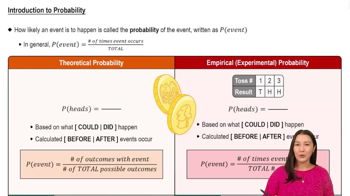
Probability is a measure of the likelihood that an event will occur, expressed as a number between 0 and 1. A probability of 0 indicates an impossible event, while a probability of 1 indicates a certain event. In this context, the probability of selecting the winning door can be calculated by dividing the number of favorable outcomes by the total number of possible outcomes.
Recommended video:
5:37
Introduction to Probability

Random Selection

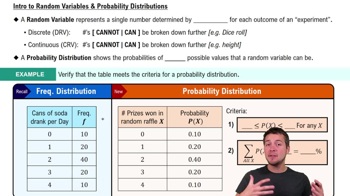
Random selection refers to the process of choosing an item or outcome from a set in such a way that each item has an equal chance of being selected. In the game show scenario, the contestant randomly selects one of four doors, meaning each door has an equal probability of being chosen, which is crucial for determining the probability of winning.
Recommended video:
Guided course
07:09
Intro to Random Variables & Probability Distributions

Favorable Outcomes

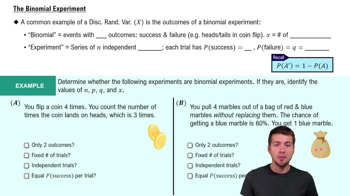
Favorable outcomes are the specific results in a probability scenario that lead to a successful event. In the case of the game show, there is one favorable outcome (selecting the door that doubles the money) out of four possible outcomes (the four doors). Understanding favorable outcomes is essential for calculating the overall probability of an event.
Recommended video:
Guided course
06:00
The Binomial Experiment
Related Practice
Textbook Question

True or False? In Exercises 3-6, determine whether the statement is true or false. If it is false, rewrite it as a true statement.

3. A combination is an ordered arrangement of objects.

101
views

Textbook Question

Cards In Exercises 59-62, you are dealt a hand of five cards from a standard deck of 52 playing cards.

62. Find the probability of being dealt three of a kind (the other two cards are different from each other).

146
views
Textbook Question

Boy or Girl? In Exercises 71-74, a couple plans to have three children. Each child is equally likely to be a boy or a girl.

74. What is the probability that at least one child is a boy?

111
views
Textbook Question

Recognizing Mutually Exclusive Events In Exercises 9–12, determine whether the events are mutually exclusive. Explain your reasoning.

10. Event A: Randomly select a student with a birthday in April.

Event B: Randomly select a student with a birthday in May.

144
views
Textbook Question

Classifying Types of Probability In Exercises 53-58, classify the statement as an example of classical probability, empirical probability, or subjective probability. Explain your reasoning.

55. An analyst feels that the probability of a team winning an upcoming game is 60%.

114
views
Textbook Question

Finding the Probability of the Complement of an Event The age distribution of the residents of Ithaca, New York, is shown at the left. In Exercises 59-62, find the probability of the event. (Source: U.S. Census Bureau)

61. Event C: A randomly chosen resident of Ithaca is not less than 18 years old.

128
views