Which Is More Likely? Assume that the fertility rates in Exercise 32 are normally distributed. Are you more likely to randomly select a state with a fertility rate of less than 65 or to randomly select a sample of 15 states in which the mean of the state fertility rates is less than 65? Explain.
Table of contents
- 1. Intro to Stats and Collecting Data1h 14m
- 2. Describing Data with Tables and Graphs1h 55m
- 3. Describing Data Numerically2h 5m
- 4. Probability2h 16m
- 5. Binomial Distribution & Discrete Random Variables3h 6m
- 6. Normal Distribution and Continuous Random Variables2h 11m
- 7. Sampling Distributions & Confidence Intervals: Mean3h 23m
- Sampling Distribution of the Sample Mean and Central Limit Theorem19m
- Distribution of Sample Mean - Excel23m
- Introduction to Confidence Intervals15m
- Confidence Intervals for Population Mean1h 18m
- Determining the Minimum Sample Size Required12m
- Finding Probabilities and T Critical Values - Excel28m
- Confidence Intervals for Population Means - Excel25m
- 8. Sampling Distributions & Confidence Intervals: Proportion1h 25m
- 9. Hypothesis Testing for One Sample3h 29m
- 10. Hypothesis Testing for Two Samples4h 50m
- Two Proportions1h 13m
- Two Proportions Hypothesis Test - Excel28m
- Two Means - Unknown, Unequal Variance1h 3m
- Two Means - Unknown Variances Hypothesis Test - Excel12m
- Two Means - Unknown, Equal Variance15m
- Two Means - Unknown, Equal Variances Hypothesis Test - Excel9m
- Two Means - Known Variance12m
- Two Means - Sigma Known Hypothesis Test - Excel21m
- Two Means - Matched Pairs (Dependent Samples)42m
- Matched Pairs Hypothesis Test - Excel12m
- 11. Correlation1h 24m
- 12. Regression1h 50m
- 13. Chi-Square Tests & Goodness of Fit2h 21m
- 14. ANOVA1h 57m
7. Sampling Distributions & Confidence Intervals: Mean
Sampling Distribution of the Sample Mean and Central Limit Theorem
Problem 8.1.20e
Textbook Question
"Upper Leg Length The upper leg length of 20- to 29-year-old males is approximately normal with a mean length of 43.7 cm and a standard deviation of 4.2 cm.
Source: “Anthropometric Reference Data for Children and Adults: U.S. Population, 1999–2002”; Volume 361, July 7, 2005.
e. A random sample of 15 males who are 20–29 years old results in a mean upper leg length of 46 cm. Do you find this result unusual? Why?"
Verified step by step guidance1
Identify the population parameters given: the mean upper leg length \(\mu = 43.7\) cm and the standard deviation \(\sigma = 4.2\) cm for males aged 20 to 29.
Recognize that the sample size is \(n = 15\) and the sample mean is \(\bar{x} = 46\) cm.
Since the population distribution is approximately normal, the sampling distribution of the sample mean \(\bar{X}\) is also normal with mean \(\mu\) and standard error \(SE = \frac{\sigma}{\sqrt{n}}\).
Calculate the standard error using the formula:
\(SE = \frac{4.2}{\sqrt{15}}\)
Compute the z-score to determine how many standard errors the sample mean is from the population mean using:
\(z = \frac{\bar{x} - \mu}{SE} = \frac{46 - 43.7}{SE}\)
Then, compare this z-score to common critical values (e.g., \(\pm 2\)) to decide if the result is unusual.
Verified video answer for a similar problem:This video solution was recommended by our tutors as helpful for the problem above
Video duration:
3mPlay a video:
Was this helpful?
Key Concepts
Here are the essential concepts you must grasp in order to answer the question correctly.
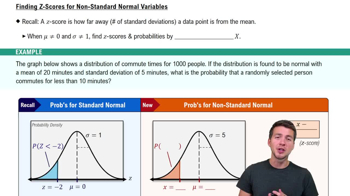
Normal Distribution
The normal distribution is a continuous probability distribution characterized by a symmetric, bell-shaped curve. It is defined by its mean and standard deviation, which determine the center and spread of the data. Many natural measurements, like upper leg length, approximate this distribution, allowing for probability calculations and inference.
Recommended video:
Guided course
Finding Z-Scores for Non-Standard Normal Variables
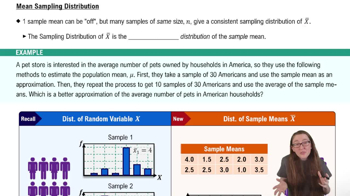
Sampling Distribution of the Sample Mean
The sampling distribution of the sample mean describes the distribution of means from all possible samples of a given size drawn from a population. It is approximately normal if the population is normal or the sample size is large, with mean equal to the population mean and standard deviation equal to the population standard deviation divided by the square root of the sample size.
Recommended video:
Sampling Distribution of Sample Mean
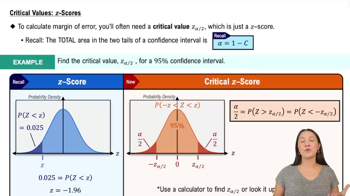
Z-Score and Unusual Values
A z-score measures how many standard deviations a data point or sample mean is from the population mean. Values with z-scores beyond ±2 are often considered unusual. Calculating the z-score for the sample mean helps determine if the observed mean of 46 cm is significantly different from the population mean of 43.7 cm.
Recommended video:
Critical Values: z Scores
Watch next
Master Sampling Distribution of Sample Mean with a bite sized video explanation from Patrick
Start learningRelated Videos
Related Practice
Textbook Question
27
views