The age of a person is commonly considered to be a continuous random variable. Could it be considered a discrete random variable instead? Explain.
Table of contents
- 1. Intro to Stats and Collecting Data1h 14m
- 2. Describing Data with Tables and Graphs1h 55m
- 3. Describing Data Numerically2h 5m
- 4. Probability2h 16m
- 5. Binomial Distribution & Discrete Random Variables3h 6m
- 6. Normal Distribution and Continuous Random Variables2h 11m
- 7. Sampling Distributions & Confidence Intervals: Mean3h 23m
- Sampling Distribution of the Sample Mean and Central Limit Theorem19m
- Distribution of Sample Mean - Excel23m
- Introduction to Confidence Intervals15m
- Confidence Intervals for Population Mean1h 18m
- Determining the Minimum Sample Size Required12m
- Finding Probabilities and T Critical Values - Excel28m
- Confidence Intervals for Population Means - Excel25m
- 8. Sampling Distributions & Confidence Intervals: Proportion1h 25m
- 9. Hypothesis Testing for One Sample3h 29m
- 10. Hypothesis Testing for Two Samples4h 50m
- Two Proportions1h 13m
- Two Proportions Hypothesis Test - Excel28m
- Two Means - Unknown, Unequal Variance1h 3m
- Two Means - Unknown Variances Hypothesis Test - Excel12m
- Two Means - Unknown, Equal Variance15m
- Two Means - Unknown, Equal Variances Hypothesis Test - Excel9m
- Two Means - Known Variance12m
- Two Means - Sigma Known Hypothesis Test - Excel21m
- Two Means - Matched Pairs (Dependent Samples)42m
- Matched Pairs Hypothesis Test - Excel12m
- 11. Correlation1h 24m
- 12. Regression1h 50m
- 13. Chi-Square Tests & Goodness of Fit2h 21m
- 14. ANOVA1h 57m
1. Intro to Stats and Collecting Data
Intro to Stats
Problem 1.2.26e
Textbook Question
"Putting It Together: Passive Smoke? The following abstract appears in The New England Journal of Medicine:BACKGROUNDThe relation between passive smoking and lung cancer is of great public health importance. Some previous studies have suggested that exposure to environmental tobacco smoke in the household can cause lung cancer, but others have found no effect. Smoking by the spouse has been the most commonly used measure of this exposure.METHODSIn order to determine whether lung cancer is associated with exposure to tobacco smoke within the household, we conducted a case-control study of 191 patients with lung cancer who had never smoked and an equal number of persons without lung cancer who had never smoked. Lifetime residential histories including information on exposure to environmental tobacco smoke were compiled and analyzed. Exposure was measured in terms of “smoker-years,” determined by multiplying the number of years in each residence by the number of smokers in the household.RESULTSHousehold exposure to 25 or more smoker-years during childhood and adolescence doubled the risk of lung cancer. Approximately 15 percent of the control subjects who had never smoked reported this level of exposure. Household exposure of less than 25 smoker-years during childhood and adolescence did not increase the risk of lung cancer. Exposure to a spouse’s smoking, which constituted less than one third of total household exposure on average, was not associated with an increase in risk.CONCLUSIONSThe possibility of recall bias and other methodologic problems may influence the results of case-control studies of environmental tobacco smoke. Nonetheless, our findings regarding exposure during early life suggest that approximately 17 percent of lung cancers among nonsmokers can be attributed to high levels of exposure to cigarette smoke during childhood and adolescence.
Can you identify any lurking variables that may have affected this study?"
Verified step by step guidance1
Understand the concept of lurking variables: these are variables that are not included in the study but may influence both the explanatory variable (exposure to tobacco smoke) and the response variable (lung cancer), potentially confounding the results.
Consider environmental factors that might correlate with both household smoking and lung cancer risk, such as air pollution, occupational exposures, or socioeconomic status, which were not explicitly controlled for in the study.
Think about genetic predispositions or family history of lung cancer that could affect lung cancer risk independently of passive smoking but might be unevenly distributed between cases and controls.
Reflect on lifestyle factors like diet, physical activity, or exposure to other carcinogens that might differ between the groups and influence lung cancer risk, yet were not accounted for in the analysis.
Recognize that recall bias itself can act as a lurking variable, where cases might remember or report exposure differently than controls, thus affecting the observed association.
Verified video answer for a similar problem:This video solution was recommended by our tutors as helpful for the problem above
Video duration:
4mPlay a video:
Was this helpful?
Key Concepts
Here are the essential concepts you must grasp in order to answer the question correctly.
Lurking Variables
Lurking variables are hidden factors not accounted for in a study that can influence both the independent and dependent variables, potentially confounding the results. Identifying them is crucial because they may create a false association or mask a true relationship between variables, leading to incorrect conclusions.
Recommended video:
Guided course
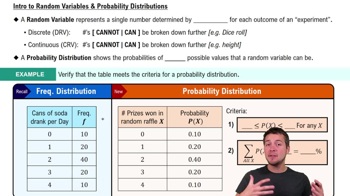
Intro to Random Variables & Probability Distributions
Case-Control Study Design
A case-control study compares individuals with a condition (cases) to those without (controls) to identify factors associated with the condition. This retrospective design is efficient for rare diseases but is susceptible to biases like recall bias and confounding, which must be carefully considered when interpreting results.
Recommended video:
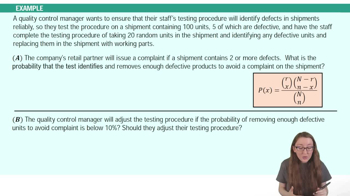
Introduction to the Hypergeometric Distribution
Recall Bias
Recall bias occurs when participants in a study remember past exposures differently based on their disease status, often over-reporting or under-reporting certain factors. In case-control studies, this can distort the association between exposure and outcome, especially when relying on self-reported historical data.
Recommended video:
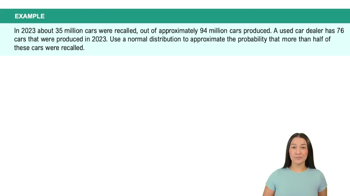
Using the Normal Distribution to Approximate Binomial Probabilities Example 1
Watch next
Master Introduction to Statistics Channel with a bite sized video explanation from Patrick
Start learningRelated Videos
Related Practice
Textbook Question
25
views