
Ch. 3 - Probability
Larson - Elementary Statistics: Picturing the World 8th Edition
Larson8th EditionElementary Statistics: Picturing the WorldISBN: 9780137493470Not the one you use?Change textbook
Chapter 3, Problem 3.2.26a

"Using the Multiplication Rule In Exercises 19-32, use the Multiplication Rule.
26. Worst President In a sample of 1500 adult U.S. citizens, 690 said that Donald Trump was the worst president in U.S. history. Three adult U.S. citizens are selected at random.
(Adapted from YouGov)
a. Find the probability that all three adult U.S. citizens say that Donald Trump was the worst president in U.S. history."

Verified step by step guidance
1
Step 1: Understand the problem. We are tasked with finding the probability that all three randomly selected adult U.S. citizens from the sample say that Donald Trump was the worst president in U.S. history. This involves using the Multiplication Rule for independent events.
Step 2: Define the probability of a single event. From the sample, 690 out of 1500 adult U.S. citizens said that Donald Trump was the worst president. The probability of selecting one person who holds this opinion is given by P(A) = 690 / 1500.
Step 3: Assume independence. Since we are selecting three individuals at random, we assume that the selections are independent. This means the probability of each selection does not affect the others.
Step 4: Apply the Multiplication Rule. The probability of all three selected individuals saying that Donald Trump was the worst president is the product of the probabilities of each individual selection. This can be expressed as P(All three) = P(A) × P(A) × P(A), or equivalently P(All three) = (690 / 1500) × (690 / 1500) × (690 / 1500).
Step 5: Simplify the expression. To find the final probability, simplify the product of the three fractions. However, since we are focusing on the process, you can stop here with the formula ready for calculation.

Verified video answer for a similar problem:

This video solution was recommended by our tutors as helpful for the problem above.
Video duration:
2m
Was this helpful?

Key Concepts

Here are the essential concepts you must grasp in order to answer the question correctly.

Multiplication Rule of Probability

The Multiplication Rule states that the probability of two or more independent events occurring together is the product of their individual probabilities. In this context, if the selection of each adult citizen is independent, the overall probability of all three citizens agreeing on a statement can be calculated by multiplying the probability of one citizen agreeing by itself for each selection.
Recommended video:
05:17
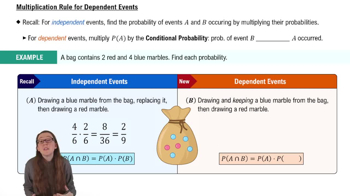
Multiplication Rule: Dependent Events

Probability Calculation

Probability is a measure of the likelihood that a particular event will occur, expressed as a number between 0 and 1. In this scenario, the probability that a randomly selected citizen believes Donald Trump is the worst president is calculated by dividing the number of citizens who hold that belief (690) by the total number of citizens surveyed (1500). This value is then used in the Multiplication Rule.
Recommended video:
Guided course
07:09
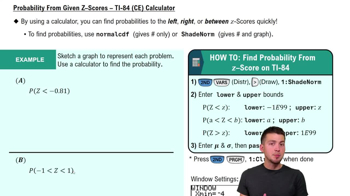
Probability From Given Z-Scores - TI-84 (CE) Calculator

Independent Events

Independent events are those whose outcomes do not affect each other. In this problem, the selection of one adult citizen does not influence the selection of another. This independence is crucial for applying the Multiplication Rule, as it allows us to treat the selections as separate events when calculating the overall probability of all selected citizens sharing the same opinion.
Recommended video:
05:54
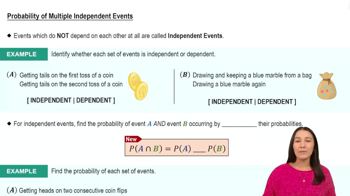
Probability of Multiple Independent Events
Related Practice
Textbook Question

"Finding Conditional Probabilities In Exercises 7 and 8, use the table to find each conditional probability.

8. Retirement Savings The table shows the results of a survey in which 250 male and 250 female workers ages 25 to 64 were asked if they contribute to a retirement savings plan at

work.

a. Find the probability that a randomly selected worker contributes to a retirement savings plan at work, given that the worker is male.

"

53
views
Textbook Question

50. Investment Committee A company has 200 employees, consisting of 144 women and 56 men. The company wants to select five employees to serve as an investment committee.

a. Use technology to find the number of ways that 5 employees can be selected from 200.

80
views
Textbook Question

Finding Conditional Probabilities In Exercises 7 and 8, use the table to find each conditional probability.

7. Business Degrees The table shows the numbers of male and female students in the United States who received bachelor's degrees in business and nonbusiness fields in a recent year. (Source: National Center for Educational Statistics)

a. Find the probability that a randomly selected bachelor's degree-earning student is male, given that the degree is in business.

91
views
Textbook Question

66. Access Code An access code consists of six characters. For each character, any letter or number can be used, with the exceptions that the first character cannot be 0 and the last two characters must be odd numbers.

a. What is the probability of randomly selecting the correct access code on the first try?

131
views
Textbook Question

"Using the Multiplication Rule In Exercises 19-32, use the Multiplication Rule.

21. BRCA1 Gene Research has shown that approximately 1 woman in 400 carries a mutation of the BRCA1 gene. About 64% of women with this mutation develop breast

cancer. Find the probability that a randomly selected woman will carry the mutation of the BRCA1 gene and will develop breast cancer. (Source: National Cancer Institute)

53
views
Textbook Question

"1. What is the difference between independent and dependent events?

182
views