Find a cofunction with the same value as the given expression. csc 35°
Verified step by step guidance
1
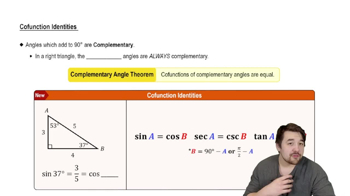
Recall the cofunction identity for cosecant: \( \csc \theta = \sec (90^\circ - \theta) \). This means that the cosecant of an angle is equal to the secant of its complement.
Identify the given angle \( \theta = 35^\circ \). To find the cofunction, calculate the complement of this angle: \( 90^\circ - 35^\circ = 55^\circ \).
Apply the cofunction identity: \( \csc 35^\circ = \sec 55^\circ \). This shows that \( \sec 55^\circ \) is the cofunction with the same value as \( \csc 35^\circ \).
Understand that this works because sine and cosine are cofunctions, and since \( \csc \theta = \frac{1}{\sin \theta} \) and \( \sec \theta = \frac{1}{\cos \theta} \), the reciprocal relationship holds for their cofunctions as well.
Therefore, the expression \( \csc 35^\circ \) can be rewritten as \( \sec 55^\circ \), which is the cofunction with the same value.
Verified video answer for a similar problem:
This video solution was recommended by our tutors as helpful for the problem above
Video duration:
1m
Play a video:
0 Comments
Key Concepts
Here are the essential concepts you must grasp in order to answer the question correctly.
Cosecant Function (csc)
The cosecant function is the reciprocal of the sine function, defined as csc θ = 1/sin θ. It represents the ratio of the hypotenuse to the opposite side in a right triangle. Understanding csc is essential to relate it to other trigonometric functions.
Cofunction identities relate trigonometric functions of complementary angles, such as sin(90° - θ) = cos θ. These identities allow expressing one function in terms of another with an angle complement, which is key to finding a cofunction with the same value.
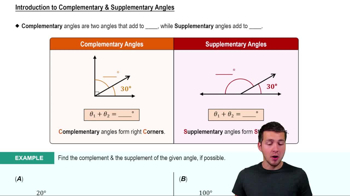
Complementary angles sum to 90°, and many trigonometric identities use this property to connect functions. Recognizing that 35° and 55° are complementary helps apply cofunction identities to rewrite csc 35° in terms of another function.

 1:16 minutes
 Verified step by step guidance
 6:22
6:22