Find a cofunction with the same value as the given expression. tan (𝜋/7)
Verified step by step guidance
1
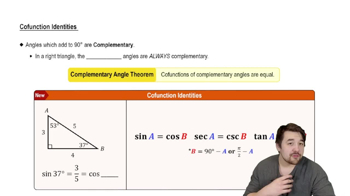
Step 1: Recall the cofunction identity for tangent, which states that \( \tan(\theta) = \cot(\frac{\pi}{2} - \theta) \). This identity helps us find a cofunction with the same value.
Step 2: Identify the given angle \( \theta = \frac{\pi}{7} \). We need to find the cofunction using the identity from Step 1.
Step 3: Substitute \( \theta = \frac{\pi}{7} \) into the cofunction identity: \( \tan(\frac{\pi}{7}) = \cot(\frac{\pi}{2} - \frac{\pi}{7}) \).
Step 4: Simplify the expression \( \frac{\pi}{2} - \frac{\pi}{7} \). To do this, find a common denominator and perform the subtraction.
Step 5: The result from Step 4 gives you the angle for the cotangent function. Therefore, \( \tan(\frac{\pi}{7}) \) is equal to \( \cot(\text{angle from Step 4}) \).
Verified video answer for a similar problem:
This video solution was recommended by our tutors as helpful for the problem above
Video duration:
2m
Play a video:
0 Comments
Key Concepts
Here are the essential concepts you must grasp in order to answer the question correctly.
Cofunction Identities
Cofunction identities in trigonometry relate the values of trigonometric functions of complementary angles. For example, the sine of an angle is equal to the cosine of its complement, and similarly for tangent and cotangent. This means that for any angle θ, the identity tan(θ) = cot(π/2 - θ) holds true, allowing us to find cofunctions that share the same value.
The tangent function, denoted as tan(θ), is defined as the ratio of the opposite side to the adjacent side in a right triangle. It can also be expressed in terms of sine and cosine as tan(θ) = sin(θ)/cos(θ). Understanding the properties and behavior of the tangent function is essential for solving problems involving angles and their relationships.
In trigonometry, angles can be measured in degrees or radians, with radians being the standard unit in mathematical contexts. The angle π/7 radians corresponds to approximately 25.7 degrees. Familiarity with converting between these two units and understanding their implications in trigonometric functions is crucial for accurately interpreting and solving trigonometric problems.