Find the exact value of each real number y if it exists. Do not use a calculator. y = csc⁻¹ √2/2
Verified step by step guidance
1
Recall that \( \csc^{-1}(x) \) is the inverse cosecant function, which means \( y = \csc^{-1}(\frac{\sqrt{2}}{2}) \) implies \( \csc(y) = \frac{\sqrt{2}}{2} \).
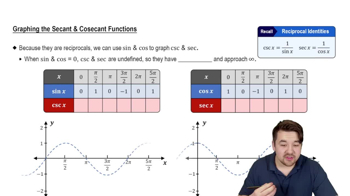
Remember that \( \csc(y) = \frac{1}{\sin(y)} \), so \( \frac{1}{\sin(y)} = \frac{\sqrt{2}}{2} \).
Solve for \( \sin(y) \) by taking the reciprocal of both sides: \( \sin(y) = \frac{2}{\sqrt{2}} \).
Determine if there is a real number \( y \) such that \( \sin(y) = \sqrt{2} \). Since \( \sin(y) \) must be between -1 and 1, there is no real number \( y \) that satisfies this equation.
Verified video answer for a similar problem:
This video solution was recommended by our tutors as helpful for the problem above
Play a video:
0 Comments
Key Concepts
Here are the essential concepts you must grasp in order to answer the question correctly.
Inverse Trigonometric Functions
Inverse trigonometric functions, such as csc⁻¹ (cosecant inverse), are used to find angles when given a trigonometric ratio. For example, csc⁻¹(x) gives the angle whose cosecant is x. Understanding these functions is crucial for solving problems involving angles and their corresponding ratios.
The cosecant function is defined as the reciprocal of the sine function, expressed as csc(θ) = 1/sin(θ). This means that if sin(θ) = √2/2, then csc(θ) = 2/√2. Recognizing the relationship between sine and cosecant helps in determining the angles associated with specific values.
Special angles, such as 30°, 45°, and 60°, have known sine and cosine values that are commonly used in trigonometric calculations. For instance, sin(45°) = √2/2. Identifying these angles allows for easier computation and understanding of trigonometric functions and their inverses.


 Verified step by step guidance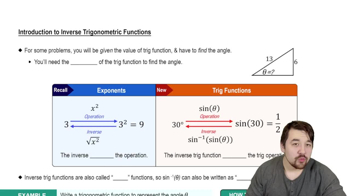
 4:28
4:28