Write each trigonometric expression as an algebraic expression in u, for u > 0. tan (arcsec (√1―u²) / u)
Verified step by step guidance
1
Recognize that \( \text{arcsec}(x) \) is the inverse of \( \sec(\theta) \), meaning \( \sec(\theta) = x \).
Set \( \theta = \text{arcsec}\left(\frac{\sqrt{1-u^2}}{u}\right) \), which implies \( \sec(\theta) = \frac{\sqrt{1-u^2}}{u} \).
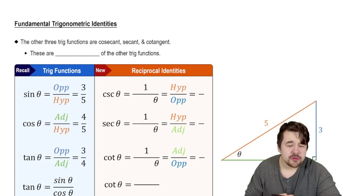
Use the identity \( \sec(\theta) = \frac{1}{\cos(\theta)} \) to find \( \cos(\theta) = \frac{u}{\sqrt{1-u^2}} \).
Use the Pythagorean identity \( \sin^2(\theta) + \cos^2(\theta) = 1 \) to find \( \sin(\theta) \).
Finally, use \( \tan(\theta) = \frac{\sin(\theta)}{\cos(\theta)} \) to express \( \tan(\theta) \) as an algebraic expression in terms of \( u \).
Verified video answer for a similar problem:
This video solution was recommended by our tutors as helpful for the problem above
Play a video:
0 Comments
Key Concepts
Here are the essential concepts you must grasp in order to answer the question correctly.
Arcsecant Function
The arcsecant function, denoted as arcsec(x), is the inverse of the secant function. It returns the angle whose secant is x, and is defined for x ≥ 1 or x ≤ -1. Understanding this function is crucial for converting expressions involving arcsec into more manageable algebraic forms.
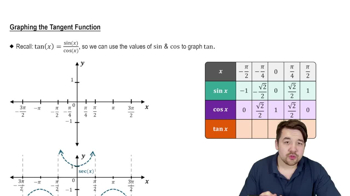
The tangent function, tan(θ), is defined as the ratio of the opposite side to the adjacent side in a right triangle. It can also be expressed as sin(θ)/cos(θ). In the context of the given expression, recognizing how to manipulate the tangent function in relation to the angles derived from arcsec is essential for simplification.
Trigonometric identities are equations that involve trigonometric functions and are true for all values of the variables involved. Key identities, such as the Pythagorean identity and angle sum formulas, are vital for transforming and simplifying trigonometric expressions into algebraic forms. Mastery of these identities aids in solving complex trigonometric problems.

 Verified step by step guidance
 5:57
5:57