Solve each equation for exact solutions. arccos x + 2 arcsin √3/2 = π
Verified step by step guidance
1
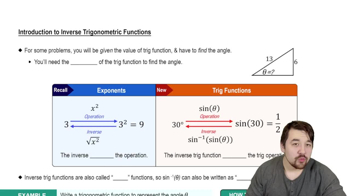
Recognize that the equation involves inverse trigonometric functions: \( \arccos(x) \) and \( \arcsin(\sqrt{3}/2) \).
Recall that \( \arcsin(\sqrt{3}/2) \) is the angle whose sine is \( \sqrt{3}/2 \). Determine this angle using the unit circle.
Substitute the value of \( \arcsin(\sqrt{3}/2) \) into the equation, simplifying it to \( \arccos(x) + 2 \times \text{(angle)} = \pi \).
Isolate \( \arccos(x) \) by subtracting \( 2 \times \text{(angle)} \) from both sides of the equation.
Solve for \( x \) by taking the cosine of both sides, using the identity \( x = \cos(\text{resulting angle}) \).
Verified video answer for a similar problem:
This video solution was recommended by our tutors as helpful for the problem above
Play a video:
Was this helpful?
Key Concepts
Here are the essential concepts you must grasp in order to answer the question correctly.
Inverse Trigonometric Functions
Inverse trigonometric functions, such as arccos and arcsin, are used to find angles when given the value of a trigonometric function. For example, arccos x gives the angle whose cosine is x, while arcsin y gives the angle whose sine is y. Understanding these functions is crucial for solving equations involving angles and their relationships.
Trigonometric identities are equations that involve trigonometric functions and are true for all values of the variables involved. Key identities include the Pythagorean identity, sine and cosine relationships, and angle sum formulas. These identities can simplify complex equations and help in finding exact solutions in trigonometric problems.
Exact values of trigonometric functions refer to specific angles where the sine, cosine, and tangent values can be expressed as simple fractions or radicals. For instance, the sine of 60 degrees is √3/2. Knowing these exact values is essential for solving equations involving trigonometric functions, as they provide precise solutions without approximation.