Ch. 5 - Trigonometric Identities
Lial - Trigonometry 12th Edition
Lial12th EditionTrigonometryISBN: 9780136552161Not the one you use?Change textbook
Chapter 6, Problem 5.RE.24

For each expression in Column I, use an identity to choose an expression from Column II with the same value. Choices may be used once, more than once, or not at all.
sin 300°

Verified step by step guidance
1
Recall that the sine function has a period of 360°, so \( \sin 300^\circ = \sin (300^\circ - 360^\circ) = \sin (-60^\circ) \).
Use the identity for sine of a negative angle: \( \sin(-\theta) = -\sin \theta \). Applying this, \( \sin(-60^\circ) = -\sin 60^\circ \).
Recall the exact value of \( \sin 60^\circ \), which is \( \frac{\sqrt{3}}{2} \).
Therefore, \( \sin 300^\circ = -\frac{\sqrt{3}}{2} \).
Match this expression with the equivalent expression in Column II that equals \( -\sin 60^\circ \) or \( -\frac{\sqrt{3}}{2} \).

Verified video answer for a similar problem:

This video solution was recommended by our tutors as helpful for the problem above.
Was this helpful?

Key Concepts

Here are the essential concepts you must grasp in order to answer the question correctly.

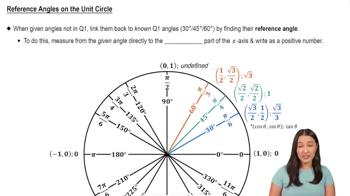
Reference Angles and Quadrants

Understanding reference angles helps simplify trigonometric expressions by relating angles greater than 90° to acute angles. The quadrant in which the angle lies determines the sign (positive or negative) of the sine, cosine, or tangent values.
Recommended video:
5:31
Reference Angles on the Unit Circle

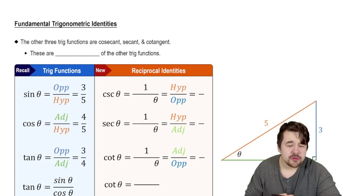
Trigonometric Identities

Trigonometric identities, such as the angle subtraction or addition formulas and co-function identities, allow rewriting expressions in equivalent forms. For example, sin(300°) can be expressed using sin(360° - 60°) and the identity sin(360° - θ) = -sin(θ).
Recommended video:
5:32
Fundamental Trigonometric Identities

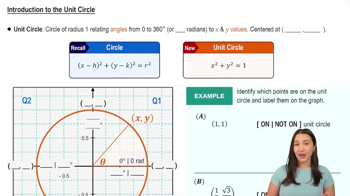
Unit Circle Values

The unit circle provides exact values for sine and cosine at standard angles like 30°, 45°, 60°, and their multiples. Knowing these values helps quickly evaluate expressions like sin(300°), which corresponds to a known point on the unit circle.
Recommended video:
06:11
Introduction to the Unit Circle