Find each exact function value. See Example 3. sin π/3
Verified step by step guidance
1
Recall that the angle \( \frac{\pi}{3} \) radians corresponds to 60 degrees in the unit circle.
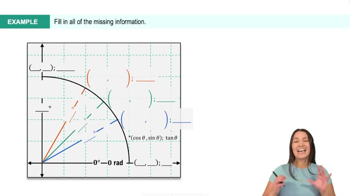
Identify the coordinates of the point on the unit circle at \( \frac{\pi}{3} \). The coordinates are \( \left( \cos \frac{\pi}{3}, \sin \frac{\pi}{3} \right) \).
Use the known exact values for sine and cosine at special angles. For \( \frac{\pi}{3} \), \( \sin \frac{\pi}{3} = \frac{\sqrt{3}}{2} \).
Write down the exact value of \( \sin \frac{\pi}{3} \) using the known value from the unit circle.
Verify your answer by considering the properties of the sine function in the first quadrant, where sine values are positive.
Verified video answer for a similar problem:
This video solution was recommended by our tutors as helpful for the problem above
Play a video:
0 Comments
Key Concepts
Here are the essential concepts you must grasp in order to answer the question correctly.
Unit Circle and Special Angles
The unit circle is a circle with radius 1 centered at the origin, used to define trigonometric functions for all angles. Special angles like π/3, π/4, and π/6 have well-known sine and cosine values derived from equilateral and right triangles, enabling exact function evaluation without a calculator.
The sine of an angle in the unit circle is the y-coordinate of the corresponding point on the circle. For angles like π/3, sine values correspond to specific ratios from special triangles, such as sin(π/3) = √3/2, reflecting the height of the triangle relative to its hypotenuse.
Exact trigonometric values are expressed in simplified radical form or fractions, not decimals, providing precise results. Recognizing when to use exact values, like sin(π/3) = √3/2, is essential for accuracy in proofs and symbolic calculations.

 Verified step by step guidance
 06:11
06:11