Use the law of sines to find the indicated part of each triangle ABC.
Find B if C = 51.3°, c = 68.3 m, b = 58.2 m
Verified step by step guidance
1
Identify the given values: angle \( C = 51.3^\circ \), side \( c = 68.3 \text{ m} \), and side \( b = 58.2 \text{ m} \).
Recall the Law of Sines: \( \frac{a}{\sin A} = \frac{b}{\sin B} = \frac{c}{\sin C} \).
Use the Law of Sines to set up the equation: \( \frac{b}{\sin B} = \frac{c}{\sin C} \).
Substitute the known values into the equation: \( \frac{58.2}{\sin B} = \frac{68.3}{\sin 51.3^\circ} \).
Solve for \( \sin B \) by cross-multiplying and then use the inverse sine function to find angle \( B \).
Verified video answer for a similar problem:
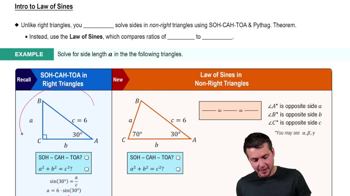
This video solution was recommended by our tutors as helpful for the problem above
Play a video:
Was this helpful?
Key Concepts
Here are the essential concepts you must grasp in order to answer the question correctly.
Law of Sines
The Law of Sines states that in any triangle, the ratio of the length of a side to the sine of its opposite angle is constant. This can be expressed as a/b = sin(A)/sin(B) = c/sin(C). It is particularly useful for solving triangles when two angles and one side (AAS or ASA) or two sides and a non-included angle (SSA) are known.
In triangles, the relationship between angles and sides is crucial. The larger the angle, the longer the opposite side. This principle helps in determining unknown angles or sides when some values are given, as seen in the Law of Sines, which relies on these relationships to find missing parts of the triangle.
To find an unknown angle in a triangle using the Law of Sines, one can rearrange the formula to isolate the sine of the angle. This often involves taking the inverse sine (arcsin) of the calculated ratio. It's important to consider the possible values for angles, especially in ambiguous cases where two different triangles could satisfy the given conditions.