A ship is sailing due north. At a certain point the bearing of a lighthouse 12.5 km away is N 38.8° E. Later on, the captain notices that the bearing of the lighthouse has become S 44.2° E. How far did the ship travel between the two observations of the lighthouse?
Verified step by step guidance
1
Identify the initial and final positions of the ship and the lighthouse. The initial bearing is N 38.8° E, and the final bearing is S 44.2° E.
Convert the bearings into angles from the north. The initial bearing of N 38.8° E corresponds to an angle of 38.8° east of north. The final bearing of S 44.2° E corresponds to an angle of 44.2° east of south, which is equivalent to 135.8° east of north (since 180° - 44.2° = 135.8°).
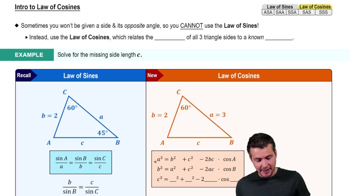
Use the Law of Cosines in the triangle formed by the initial position, final position, and the lighthouse. Let the distance traveled by the ship be denoted as 'd'. The angle between the two bearings is 135.8° - 38.8° = 97°.
Apply the Law of Cosines: \( d^2 = 12.5^2 + 12.5^2 - 2 \times 12.5 \times 12.5 \times \cos(97°) \).
Solve for 'd' to find the distance the ship traveled between the two observations.
Verified video answer for a similar problem:
This video solution was recommended by our tutors as helpful for the problem above
Play a video:
Was this helpful?
Key Concepts
Here are the essential concepts you must grasp in order to answer the question correctly.
Bearing
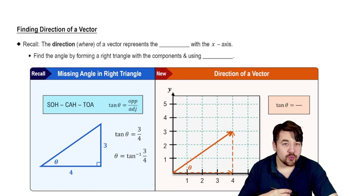
Bearing is a method of describing direction using angles measured clockwise from the north. In this question, bearings are given as N 38.8° E and S 44.2° E, indicating the angles relative to true north. Understanding how to interpret these bearings is crucial for visualizing the positions of the ship and the lighthouse in relation to each other.
Trigonometric Functions
Trigonometric functions, such as sine, cosine, and tangent, relate the angles of a triangle to the lengths of its sides. In this scenario, these functions can be used to calculate distances and angles in the triangle formed by the ship's path and the lighthouse's position. Mastery of these functions is essential for solving problems involving angles and distances in navigation.
The Law of Sines is a formula that relates the lengths of the sides of a triangle to the sines of its angles. It is particularly useful in non-right triangles, such as the one formed by the ship's two positions and the lighthouse. By applying this law, one can find unknown distances or angles, which is key to determining how far the ship traveled between the two observations.