Fill in the blank(s) to correctly complete each sentence. The sum of the measures of the angles of any triangle is ________________ .
Verified step by step guidance
1
Recall that a triangle is a polygon with three sides and three angles.
Understand that the sum of the interior angles of any polygon can be determined using the formula: \((n-2) \times 180^\circ\), where \(n\) is the number of sides.
For a triangle, \(n = 3\). Substitute \(n = 3\) into the formula: \((3-2) \times 180^\circ\).
Simplify the expression: \(1 \times 180^\circ\).
Conclude that the sum of the measures of the angles of any triangle is \(180^\circ\).
Verified video answer for a similar problem:
This video solution was recommended by our tutors as helpful for the problem above
Video duration:
2m
Play a video:
Was this helpful?
Key Concepts
Here are the essential concepts you must grasp in order to answer the question correctly.
Triangle Angle Sum Theorem
The Triangle Angle Sum Theorem states that the sum of the interior angles of any triangle is always 180 degrees. This fundamental property applies to all types of triangles, whether they are scalene, isosceles, or equilateral. Understanding this theorem is crucial for solving problems related to triangle geometry and for proving other geometric concepts.
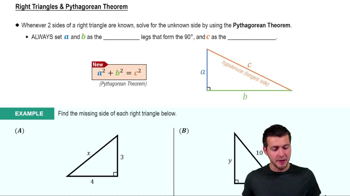
Solving Right Triangles with the Pythagorean Theorem
Types of Triangles
Triangles can be classified based on their angles into three types: acute (all angles less than 90 degrees), right (one angle exactly 90 degrees), and obtuse (one angle greater than 90 degrees). Each type adheres to the Triangle Angle Sum Theorem, reinforcing the idea that regardless of the triangle's shape, the total angle measure remains constant at 180 degrees.
The concept of the angle sum in triangles is not only theoretical but also has practical applications in various fields such as architecture, engineering, and computer graphics. By knowing that the angles sum to 180 degrees, one can determine missing angles in a triangle, which is essential for constructing accurate designs and models.