Match each equation with its polar graph from choices A–D. r = cos 2θ
Verified step by step guidance
1
Step 1: Recognize that the given equation \( r = \cos 2\theta \) is a polar equation. Polar equations are expressed in terms of \( r \) (the radius) and \( \theta \) (the angle).
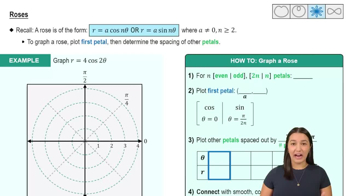
Step 2: Understand that \( r = \cos 2\theta \) represents a type of polar graph known as a 'rose curve'. Rose curves are characterized by their petal-like shapes.
Step 3: Determine the number of petals. For the equation \( r = \cos n\theta \), if \( n \) is even, the graph will have \( 2n \) petals. Here, \( n = 2 \), so the graph will have \( 4 \) petals.
Step 4: Consider the symmetry of the graph. Since the cosine function is symmetric about the x-axis, the graph of \( r = \cos 2\theta \) will also be symmetric about the x-axis.
Step 5: Match the characteristics of the graph (4 petals, symmetry about the x-axis) with the given choices A–D to identify the correct polar graph.
Verified video answer for a similar problem:
This video solution was recommended by our tutors as helpful for the problem above
Video duration:
6m
Play a video:
Was this helpful?
Key Concepts
Here are the essential concepts you must grasp in order to answer the question correctly.
Polar Coordinates
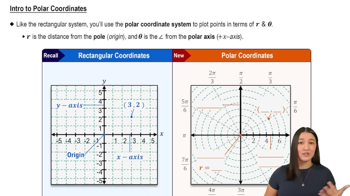
Polar coordinates represent points in a plane using a distance from a reference point (the pole) and an angle from a reference direction. In polar equations, 'r' denotes the radius (distance from the origin), and 'θ' represents the angle. Understanding how to convert between polar and Cartesian coordinates is essential for analyzing polar graphs.
Polar equations express relationships between the radius 'r' and the angle 'θ'. The equation 'r = cos 2θ' indicates that the radius varies with the cosine of twice the angle, leading to specific symmetrical patterns in the graph. Recognizing the form of these equations helps in predicting the shape and characteristics of their graphs.
Graphing polar equations involves plotting points based on the values of 'r' for various angles 'θ'. The graph of 'r = cos 2θ' will exhibit a rose curve with petals, where the number of petals is determined by the coefficient of 'θ'. Understanding how to interpret and sketch these graphs is crucial for matching equations to their corresponding polar graphs.