In Exercises 21–40, eliminate the parameter t. Then use the rectangular equation to sketch the plane curve represented by the given parametric equations. Use arrows to show the orientation of the curve corresponding to increasing values of t. (If an interval for t is not specified, assume that −∞ < t < ∞. x = t, y = 2t
Ch. 5 - Complex Numbers, Polar Coordinates and Parametric Equations

All textbooks
Blitzer 3rd Edition
Ch. 5 - Complex Numbers, Polar Coordinates and Parametric Equations
Problem 22
Blitzer 3rd Edition
Ch. 5 - Complex Numbers, Polar Coordinates and Parametric Equations
Problem 22Chapter 5, Problem 22
In Exercises 21–28, divide and express the result in standard form.
3 / 4+i
Verified step by step guidance1
Identify the given expression to simplify: \(\frac{3}{4+i}\).
To express the result in standard form (a + bi), multiply the numerator and denominator by the complex conjugate of the denominator. The complex conjugate of \$4+i\( is \)4 - i$.
Multiply numerator and denominator by \$4 - i$: \(\frac{3}{4+i} \times \frac{4 - i}{4 - i} = \frac{3(4 - i)}{(4+i)(4 - i)}\).
Simplify the denominator using the difference of squares formula: \((4+i)(4 - i) = 4^2 - (i)^2 = 16 - (-1) = 16 + 1 = 17\).
Expand the numerator: \$3(4 - i) = 12 - 3i$. So the expression becomes \(\frac{12 - 3i}{17}\). Finally, separate into real and imaginary parts: \(\frac{12}{17} - \frac{3}{17}i\).

Verified video answer for a similar problem:
This video solution was recommended by our tutors as helpful for the problem above.
Video duration:
3mWas this helpful?
Key Concepts
Here are the essential concepts you must grasp in order to answer the question correctly.
Complex Numbers and Standard Form
Complex numbers are expressed in the form a + bi, where a is the real part and b is the imaginary part. The standard form makes it easier to perform arithmetic operations and interpret the number geometrically on the complex plane.
Recommended video:
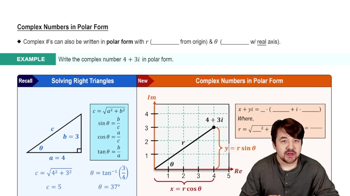
Complex Numbers In Polar Form
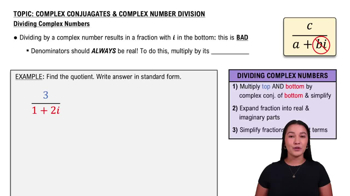
Division of Complex Numbers
Dividing complex numbers involves multiplying the numerator and denominator by the conjugate of the denominator to eliminate the imaginary part in the denominator. This process simplifies the expression into standard form.
Recommended video:
Dividing Complex Numbers
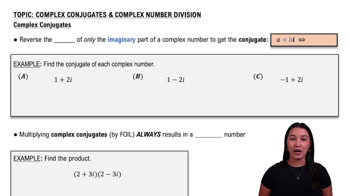
Complex Conjugate
The complex conjugate of a number a + bi is a - bi. Multiplying by the conjugate removes the imaginary component in the denominator, resulting in a real number denominator, which is essential for simplifying complex fractions.
Recommended video:
Complex Conjugates
Related Practice
Textbook Question
753
views
Textbook Question
In Exercises 13–34, test for symmetry and then graph each polar equation. r = 2 − 3 sin θ
702
views
Textbook Question
In Exercises 22–24, find the quotient z₁/z₂ of the complex numbers. Leave answers in polar form.
z₁ = 5 (cos 4π/3 + i sin 4π/3)
z₂ = 10 (cos π/3 + i sin π/3)
535
views
Textbook Question
In Exercises 11–26, plot each complex number. Then write the complex number in polar form. You may express the argument in degrees or radians. −3 + 4i
528
views
Textbook Question
In Exercises 21–28, divide and express the result in standard form. 2 / 3 - i
670
views
Textbook Question
In Exercises 21–26, use a polar coordinate system like the one shown for Exercises 1–10 to plot each point with the given polar coordinates. Then find another representation of this point in which
a. r>0, 2π < θ < 4π.
b. r<0, 0. < θ < 2π.
c. r>0, −2π. < θ < 0.
(5, π/6)
742
views