In Exercises 1–8, parametric equations and a value for the parameter t are given. Find the coordinates of the point on the plane curve described by the parametric equations corresponding to the given value of t. x = t² + 3, y = 6 − t³; t = 2
Ch. 5 - Complex Numbers, Polar Coordinates and Parametric Equations

All textbooks
Blitzer 3rd Edition
Ch. 5 - Complex Numbers, Polar Coordinates and Parametric Equations
Problem 5.27
Blitzer 3rd Edition
Ch. 5 - Complex Numbers, Polar Coordinates and Parametric Equations
Problem 5.27Chapter 5, Problem 5.27
In Exercises 21–28, divide and express the result in standard form.
2+3i / 2+i
Verified step by step guidance1
Identify the given complex division problem: \(\frac{2+3i}{2+i}\), where \(i\) is the imaginary unit with the property \(i^2 = -1\).
To divide complex numbers, multiply the numerator and denominator by the conjugate of the denominator. The conjugate of \$2+i\( is \)2 - i$.
Multiply numerator and denominator by the conjugate: \(\frac{2+3i}{2+i} \times \frac{2 - i}{2 - i} = \frac{(2+3i)(2 - i)}{(2+i)(2 - i)}\).
Expand both numerator and denominator using the distributive property (FOIL method):
- Numerator: \((2)(2) + (2)(-i) + (3i)(2) + (3i)(-i)\)
- Denominator: \((2)(2) + (2)(-i) + (i)(2) + (i)(-i)\).
Simplify the expressions by combining like terms and using \(i^2 = -1\), then write the result in the form \(a + bi\), where \(a\) and \(b\) are real numbers.

Verified video answer for a similar problem:
This video solution was recommended by our tutors as helpful for the problem above.
Video duration:
3mWas this helpful?
Key Concepts
Here are the essential concepts you must grasp in order to answer the question correctly.
Complex Number Division
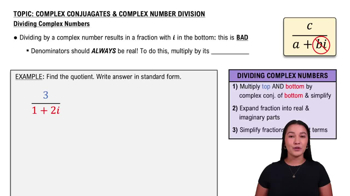
Dividing complex numbers involves expressing the quotient in a form that separates real and imaginary parts. This is typically done by multiplying numerator and denominator by the conjugate of the denominator to eliminate the imaginary part from the denominator.
Recommended video:
Dividing Complex Numbers
Complex Conjugate
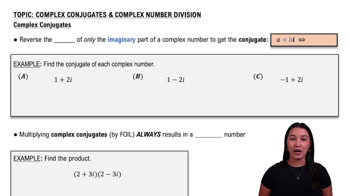
The complex conjugate of a number a + bi is a - bi. Multiplying a complex number by its conjugate results in a real number, specifically a^2 + b^2, which helps simplify division by removing the imaginary component from the denominator.
Recommended video:
Complex Conjugates
Standard Form of a Complex Number
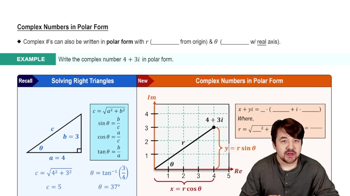
The standard form of a complex number is a + bi, where a is the real part and b is the imaginary part. Expressing results in this form makes it easier to interpret and use complex numbers in further calculations.
Recommended video:
Complex Numbers In Polar Form
Related Practice
Textbook Question
745
views
Textbook Question
In Exercises 53–64, use DeMoivre's Theorem to find the indicated power of the complex number. Write answers in rectangular form. [2(cos 40° + i sin 40°)]³
587
views
Textbook Question
_ Write −√3 + i in polar form.
540
views
Textbook Question
In Exercises 45–52, use your answers from Exercises 41–44 and the parametric equations given in Exercises 41–44 to find a set of parametric equations for the conic section or the line.
Ellipse: Center: (−2,3); Vertices: 5 units to the left and right of the center; Endpoints of Minor Axis: 2 units above and below the center
480
views
Textbook Question
In Exercises 1–10, perform the indicated operations and write the result in standard form. (3 − 4i)²
769
views
Textbook Question
In Exercises 53–56, find two different sets of parametric equations for each rectangular equation. y = x² + 4
766
views