
Step 1: Recognize that the expression is a fraction with a radical in the denominator: \( \frac{\frac{1}{2}}{1 - \frac{\sqrt{5}}{2}} \).
Step 2: Simplify the expression by multiplying both the numerator and the denominator by 2 to eliminate the fractions: \( \frac{1}{2} \times \frac{2}{2} \) and \( (1 - \frac{\sqrt{5}}{2}) \times 2 \).
Step 3: This results in the expression \( \frac{1}{2 - \sqrt{5}} \).
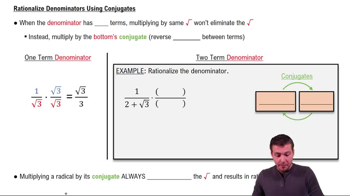
Step 4: To rationalize the denominator, multiply both the numerator and the denominator by the conjugate of the denominator: \( 2 + \sqrt{5} \).
Step 5: Simplify the resulting expression by expanding the numerator and using the difference of squares formula for the denominator: \( (2 - \sqrt{5})(2 + \sqrt{5}) = 4 - 5 = -1 \).
Verified video answer for a similar problem:
This video solution was recommended by our tutors as helpful for the problem above
Video duration:
5m
Play a video:
0 Comments
Key Concepts
Here are the essential concepts you must grasp in order to answer the question correctly.
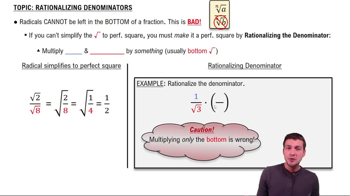
Rationalizing the Denominator
Rationalizing the denominator is a technique used to eliminate any irrational numbers from the denominator of a fraction. This is typically achieved by multiplying both the numerator and the denominator by a suitable expression that will result in a rational number in the denominator. For example, to rationalize a denominator like '1 - √5', one would multiply by the conjugate '1 + √5'.
Conjugates are pairs of binomials that have the same terms but opposite signs, such as 'a + b' and 'a - b'. When multiplied together, they yield a difference of squares, which is a rational number. In the context of simplifying fractions, using the conjugate of a binomial in the denominator helps to eliminate square roots and simplify the expression.
Simplifying fractions involves reducing them to their simplest form, where the numerator and denominator have no common factors other than 1. This process often includes factoring, canceling common terms, and applying operations to make the fraction easier to work with. In trigonometry and algebra, simplifying expressions is crucial for clearer calculations and understanding.