Graph each function over a one-period interval. y = -½ cos (πx - π)
Verified step by step guidance
1
Identify the given function: \(y = -\frac{1}{2} \cos(\pi x - \pi)\).
Recall that the general form of a cosine function is \(y = A \cos(Bx - C)\), where the period is given by \(\frac{2\pi}{|B|}\).
Calculate the period of the function: since \(B = \pi\), the period is \(\frac{2\pi}{\pi} = 2\).
Determine the one-period interval for \(x\). Since the period is 2, a natural choice is any interval of length 2, for example, \([0, 2]\) or \([-1, 1]\).
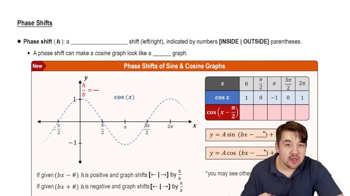
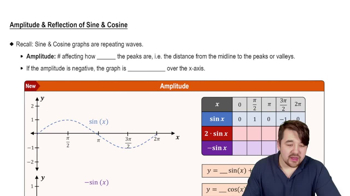
Analyze the transformations: the amplitude is \(\frac{1}{2}\) (due to the coefficient \(-\frac{1}{2}\)), the negative sign reflects the graph about the x-axis, and the phase shift is found by solving \(\pi x - \pi = 0\) which gives \(x = 1\). This means the graph is shifted right by 1 unit.
Verified video answer for a similar problem:
This video solution was recommended by our tutors as helpful for the problem above
Play a video:
0 Comments
Key Concepts
Here are the essential concepts you must grasp in order to answer the question correctly.
Period of a Trigonometric Function
The period is the length of one complete cycle of a trigonometric function. For cosine functions of the form y = cos(bx), the period is calculated as 2π divided by the absolute value of b. Understanding the period helps determine the interval over which to graph the function.
Phase shift refers to the horizontal translation of the graph caused by adding or subtracting a constant inside the function's argument. For y = cos(bx - c), the phase shift is c/b. It affects where the graph starts within the period and is essential for accurate plotting.
Amplitude is the absolute value of the coefficient multiplying the cosine function, indicating the maximum displacement from the midline. A negative coefficient reflects the graph across the x-axis. In y = -½ cos(πx - π), the amplitude is ½, and the negative sign flips the graph vertically.

 Verified step by step guidance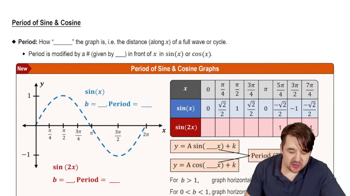
 5:33
5:33