Translational fusions between a protein of interest and a reporter protein are used to determine the subcellular location of proteins in vivo. However, fusion to a reporter protein sometimes renders the protein of interest nonfunctional because the addition of the reporter protein interferes with proper protein folding, enzymatic activity, or protein–protein interactions. You have constructed a fusion between your protein of interest and a reporter gene. How will you show that the fusion protein retains its normal biological function?
Table of contents
- 1. Introduction to Genetics51m
- 2. Mendel's Laws of Inheritance3h 37m
- 3. Extensions to Mendelian Inheritance2h 41m
- 4. Genetic Mapping and Linkage2h 28m
- 5. Genetics of Bacteria and Viruses1h 21m
- 6. Chromosomal Variation1h 48m
- 7. DNA and Chromosome Structure56m
- 8. DNA Replication1h 10m
- 9. Mitosis and Meiosis1h 34m
- 10. Transcription1h 0m
- 11. Translation58m
- 12. Gene Regulation in Prokaryotes1h 19m
- 13. Gene Regulation in Eukaryotes44m
- 14. Genetic Control of Development44m
- 15. Genomes and Genomics1h 50m
- 16. Transposable Elements47m
- 17. Mutation, Repair, and Recombination1h 6m
- 18. Molecular Genetic Tools19m
- 19. Cancer Genetics29m
- 20. Quantitative Genetics1h 26m
- 21. Population Genetics50m
- 22. Evolutionary Genetics29m
15. Genomes and Genomics
Functional Genomics
Problem 17
Textbook Question
Metagenomics studies generate very large amounts of sequence data. Provide examples of genetic insight that can be learned from metagenomics.
Verified step by step guidance1
Understand that metagenomics involves sequencing genetic material directly from environmental samples, allowing the study of microbial communities without the need for culturing organisms.
Identify that one key genetic insight from metagenomics is the discovery of new genes and metabolic pathways that were previously unknown, expanding our understanding of microbial functions and diversity.
Recognize that metagenomics can reveal the composition and relative abundance of different microbial species in a community, providing insights into microbial ecology and interactions.
Consider that metagenomics allows the detection of antibiotic resistance genes and virulence factors, which is important for understanding the spread of resistance and potential pathogenicity in microbial populations.
Note that metagenomic data can be used to study evolutionary relationships and horizontal gene transfer events among microbes, shedding light on genetic exchange and adaptation mechanisms.
Verified video answer for a similar problem:This video solution was recommended by our tutors as helpful for the problem above
Video duration:
1mPlay a video:
Was this helpful?
Key Concepts
Here are the essential concepts you must grasp in order to answer the question correctly.
Metagenomics and Environmental DNA Sequencing
Metagenomics involves sequencing genetic material directly from environmental samples, bypassing the need for culturing organisms. This approach captures the diversity of microbial communities in various habitats, enabling the study of organisms that are otherwise difficult to culture in the lab.
Recommended video:
Guided course
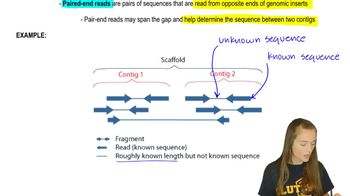
Sequencing Difficulties
Microbial Diversity and Community Structure
Metagenomic data reveal the composition and relative abundance of microbial species within a community. By analyzing sequence data, researchers can identify known and novel microbes, understand their ecological roles, and track changes in community structure under different environmental conditions.
Recommended video:
Guided course
Ribosome Structure
Functional Gene Discovery and Metabolic Potential
Beyond identifying species, metagenomics uncovers genes related to metabolic pathways, antibiotic resistance, and other functional traits. This insight helps predict the biochemical capabilities of microbial communities, such as nutrient cycling or pollutant degradation, providing a deeper understanding of ecosystem functions.
Recommended video:
Guided course
Discovery
Related Videos
Related Practice
Textbook Question
677
views
