Consider the following segment of DNA: 5'-...ATGCCAGTCACTGACTTG...-3' 3'-...TACGGTCAGTGACTGAAC...-5' How many phosphodiester bonds are required to form this segment of double-stranded DNA?
Verified step by step guidance
1
Identify the number of nucleotides in the given DNA sequence. Count the number of bases in one strand (e.g., the 5'-3' strand) since both strands are complementary and will have the same number of nucleotides.
Recall that each nucleotide in a DNA strand is connected to the next nucleotide by a phosphodiester bond. Therefore, the number of phosphodiester bonds in a single strand is equal to the number of nucleotides minus one.
Since the DNA is double-stranded, calculate the total number of phosphodiester bonds by multiplying the number of bonds in one strand by two (as each strand has its own set of phosphodiester bonds).
Note that the phosphodiester bonds are only within each strand and not between the two strands. The two strands are held together by hydrogen bonds between complementary bases, not phosphodiester bonds.
Combine the results to determine the total number of phosphodiester bonds required to form the double-stranded DNA segment.
Verified video answer for a similar problem:
This video solution was recommended by our tutors as helpful for the problem above
Video duration:
1m
Play a video:
Was this helpful?
Key Concepts
Here are the essential concepts you must grasp in order to answer the question correctly.
Phosphodiester Bonds
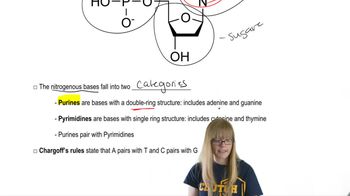
Phosphodiester bonds are covalent linkages that connect the 5' phosphate group of one nucleotide to the 3' hydroxyl group of another nucleotide in a DNA strand. These bonds form the backbone of the DNA molecule, providing structural integrity and allowing for the formation of long chains of nucleotides. Each bond is crucial for maintaining the continuity of the DNA strand.
Double-stranded DNA consists of two complementary strands that run in opposite directions, known as antiparallel orientation. Each strand is made up of nucleotides, which pair specifically (adenine with thymine, and cytosine with guanine) through hydrogen bonds. Understanding this structure is essential for determining how many phosphodiester bonds are present, as each strand contributes to the overall length of the DNA segment.
To determine the number of phosphodiester bonds in a DNA segment, one must count the nucleotides in each strand. Each nucleotide, except for the terminal ones, is linked to its neighbor by a phosphodiester bond. Therefore, the total number of bonds is equal to the total number of nucleotides minus one for each strand, as the ends do not form bonds with additional nucleotides.