One strand of a fragment of duplex DNA has the sequence 5'-ATCGACCTGATC-3'. What is the name of the bond that joins one nucleotide to another in the DNA strand?
Verified step by step guidance
1
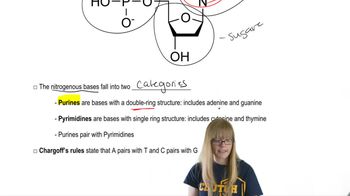
Understand that DNA is composed of nucleotides, which are joined together to form a strand. Each nucleotide consists of three components: a phosphate group, a sugar molecule (deoxyribose), and a nitrogenous base.
Recognize that the bond joining one nucleotide to another in a DNA strand is a covalent bond called a phosphodiester bond. This bond connects the phosphate group of one nucleotide to the 3' hydroxyl group of the sugar molecule in the next nucleotide.
Visualize the structure of the DNA strand: the backbone is made up of alternating sugar and phosphate groups, while the nitrogenous bases extend inward to form base pairs with the complementary strand.
Recall that the phosphodiester bond is formed during DNA synthesis by the enzyme DNA polymerase, which catalyzes the addition of nucleotides to the growing DNA strand.
Note that the directionality of the DNA strand is determined by the orientation of the phosphodiester bonds, which run from the 5' end (phosphate group) to the 3' end (hydroxyl group).
Verified video answer for a similar problem:
This video solution was recommended by our tutors as helpful for the problem above
Video duration:
1m
Play a video:
Was this helpful?
Key Concepts
Here are the essential concepts you must grasp in order to answer the question correctly.
Phosphodiester Bond
A phosphodiester bond is a type of covalent bond that links nucleotides together in a DNA strand. It forms between the phosphate group of one nucleotide and the hydroxyl group on the sugar of another nucleotide, creating a backbone that is essential for the structural integrity of DNA.
Nucleotides are the building blocks of DNA and consist of three components: a phosphate group, a five-carbon sugar (deoxyribose in DNA), and a nitrogenous base. The sequence of these nucleotides encodes genetic information, and understanding their structure is crucial for grasping how they connect through phosphodiester bonds.
DNA is structured as a double helix, composed of two strands running in opposite directions, held together by hydrogen bonds between complementary nitrogenous bases. The integrity of the DNA molecule relies on the phosphodiester bonds that form the sugar-phosphate backbone, allowing it to maintain its shape and function in genetic processes.