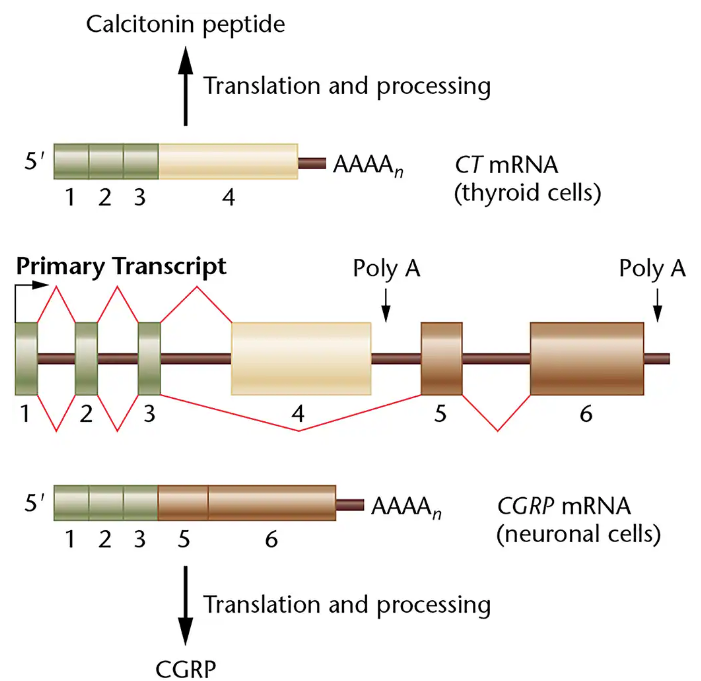
Consider the CT/CGRP example of alternative splicing show. Which different types of alternative splicing patterns are represented?
Verified step by step guidance
1
Step 1: Understand the concept of alternative splicing, which is a process by which different combinations of exons are joined together from a single pre-mRNA transcript, resulting in multiple mRNA variants and thus different protein isoforms from one gene.
Step 2: Review the CT/CGRP example in Figure 18.3 carefully, noting which exons are included or excluded in the different mRNA transcripts shown. Pay attention to any exons that are skipped, mutually exclusive, or retained.
Step 3: Identify the types of alternative splicing patterns present. Common types include exon skipping (an exon is included in one transcript but skipped in another), mutually exclusive exons (only one of two exons is included), alternative 5' splice site (different splice donor sites), alternative 3' splice site (different splice acceptor sites), and intron retention (an intron is retained in the mature mRNA).
Step 4: Match the observed splicing events in the CT/CGRP example to these categories by comparing the exon structures of the different mRNA isoforms shown in the figure.
Step 5: Summarize which specific alternative splicing patterns are represented in the CT/CGRP example based on your analysis, explaining how these patterns contribute to the diversity of the resulting proteins.
Verified video answer for a similar problem:
This video solution was recommended by our tutors as helpful for the problem above
Video duration:
2m
Play a video:
Was this helpful?
Key Concepts
Here are the essential concepts you must grasp in order to answer the question correctly.
Alternative Splicing
Alternative splicing is a process during gene expression where a single pre-mRNA transcript can be spliced in multiple ways to produce different mature mRNA variants. This allows one gene to encode multiple protein isoforms, increasing proteomic diversity without increasing gene number.
There are several common patterns of alternative splicing, including exon skipping, mutually exclusive exons, alternative 5' splice sites, alternative 3' splice sites, and intron retention. Each pattern alters the mRNA sequence differently, affecting the resulting protein structure and function.
The CT/CGRP gene is a classic example illustrating alternative splicing, where different splicing patterns produce either calcitonin (CT) or calcitonin gene-related peptide (CGRP). Understanding this example helps clarify how alternative splicing can regulate tissue-specific protein expression.