DNA replication is the process by which a double-stranded DNA molecule is copied to produce two identical DNA molecules.
This process is essential for cell division, allowing each new cell to receive an exact copy of the DNA.
Replication begins at specific locations in the DNA, known as origins of replication.
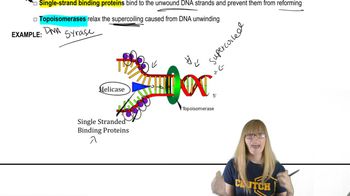
The enzyme helicase unwinds the DNA double helix, creating two single strands that serve as templates for the synthesis of new complementary strands.
DNA polymerase is the enzyme responsible for adding nucleotides to the growing DNA strand, ensuring that each new DNA molecule is an exact copy of the original.
Verified video answer for a similar problem:
This video solution was recommended by our tutors as helpful for the problem above
Video duration:
1m
Play a video:
Was this helpful?
Key Concepts
Here are the essential concepts you must grasp in order to answer the question correctly.
DNA Replication
DNA replication is the biological process by which a cell makes an identical copy of its DNA. This occurs during the S phase of the cell cycle and involves unwinding the double helix structure, followed by the synthesis of new complementary strands using existing strands as templates. The process ensures that each daughter cell receives an exact copy of the parent cell's genetic material.
Several key enzymes facilitate DNA replication, including DNA helicase, which unwinds the double helix, and DNA polymerase, which synthesizes new DNA strands by adding nucleotides complementary to the template strand. Other enzymes, such as primase and ligase, play crucial roles in initiating replication and joining Okazaki fragments on the lagging strand, respectively.
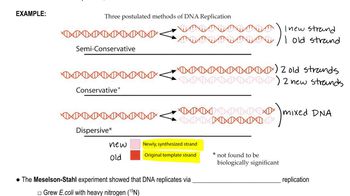
DNA replication is described as semi-conservative because each new DNA molecule consists of one original (parental) strand and one newly synthesized strand. This mechanism was confirmed by the Meselson-Stahl experiment and is essential for maintaining genetic fidelity, as it allows for the accurate transmission of genetic information from one generation to the next.