"In Problems 3–5, determine if the variable is qualitative or quantitative. If the variable is quantitative, determine if it is discrete or continuous. State the level of measurement of the variable. Video game rating system by the Entertainment Software Rating Board (EC, E, E10+, T, M, AO, RP)"
Verified step by step guidance
1
Identify the type of variable: The video game rating system categories (EC, E, E10+, T, M, AO, RP) represent labels or names for different rating groups, so this variable is qualitative (categorical).
Since the variable is qualitative, it does not represent numerical values or counts, so it is neither discrete nor continuous.
Determine the level of measurement: Because the ratings have a meaningful order (from EC to RP indicating increasing content maturity), the variable is ordinal.
Recall that ordinal variables have categories with a natural order but the differences between categories are not necessarily equal or measurable.
Summarize: The video game rating system variable is qualitative, specifically ordinal, because it classifies games into ordered categories without numeric measurement.
Verified video answer for a similar problem:
This video solution was recommended by our tutors as helpful for the problem above
Video duration:
1m
Play a video:
0 Comments
Key Concepts
Here are the essential concepts you must grasp in order to answer the question correctly.
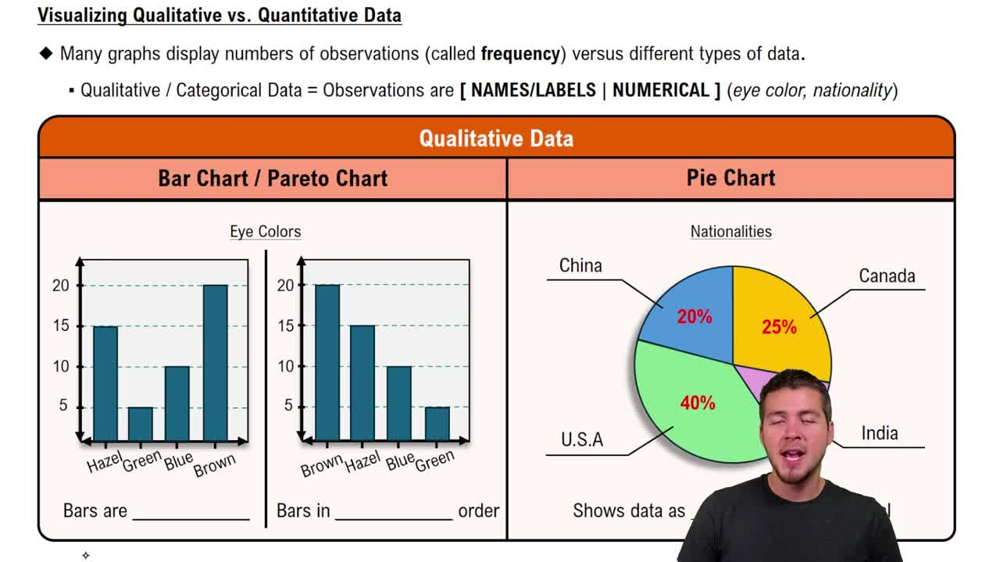
Qualitative vs. Quantitative Variables
Variables can be classified as qualitative (categorical) or quantitative (numerical). Qualitative variables describe categories or groups, such as types or labels, while quantitative variables represent measurable quantities or counts.
Quantitative variables are further divided into discrete and continuous types. Discrete variables take on countable values, often integers, while continuous variables can take any value within a range, including decimals and fractions.
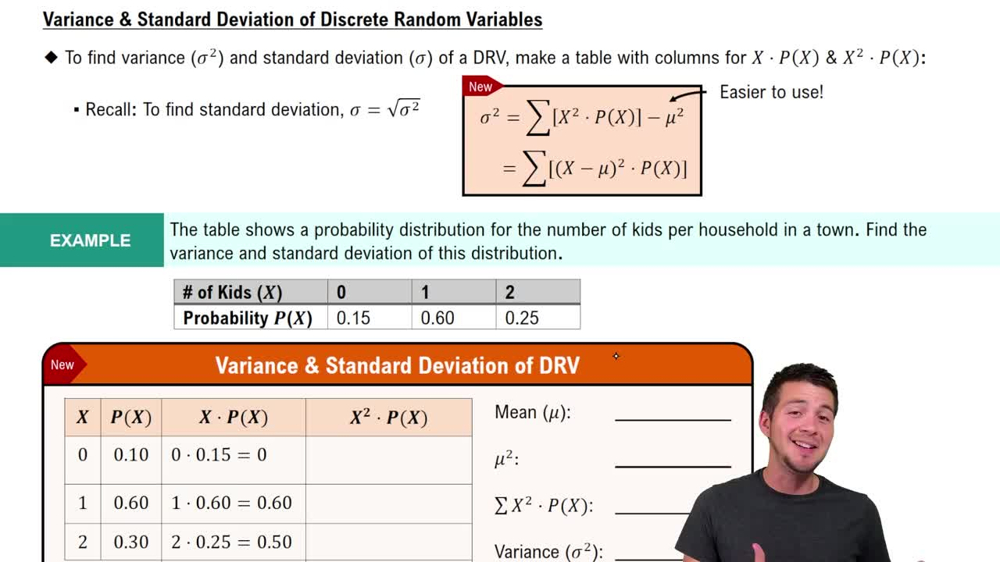
Variance & Standard Deviation of Discrete Random Variables
Levels of Measurement
The level of measurement indicates how data is categorized or measured: nominal (categories without order), ordinal (categories with order), interval (numerical with meaningful differences but no true zero), and ratio (numerical with a true zero). This affects the types of analyses possible.

 1:43 minutes
 Verified step by step guidance
 04:39
04:39