In Problems 3–5, determine if the variable is qualitative or quantitative. If the variable is quantitative, determine if it is discrete or continuous. State the level of measurement of the variable. The number of surface imperfections on a camera lens.
Verified step by step guidance
1
Identify the type of variable by understanding what it represents. The number of surface imperfections on a camera lens counts how many imperfections there are, so it represents a numerical quantity.
Since the variable counts the number of imperfections, it is a quantitative variable because it expresses a measurable amount.
Determine if the quantitative variable is discrete or continuous. Because the number of imperfections can only be whole numbers (you can't have 2.5 imperfections), it is a discrete variable.
Next, identify the level of measurement. The number of imperfections is measured on a ratio scale because it has a true zero point (zero imperfections means none) and the differences and ratios between values are meaningful.
Summarize: The variable is quantitative, discrete, and measured at the ratio level.
Verified video answer for a similar problem:
This video solution was recommended by our tutors as helpful for the problem above
Video duration:
1m
Play a video:
0 Comments
Key Concepts
Here are the essential concepts you must grasp in order to answer the question correctly.
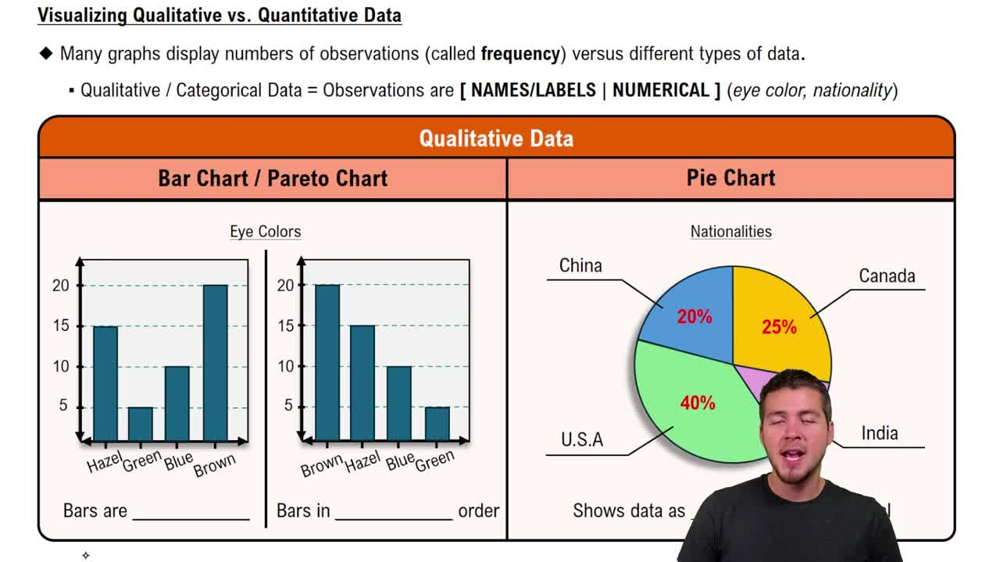
Qualitative vs. Quantitative Variables
Variables are classified as qualitative (categorical) or quantitative (numerical). Qualitative variables describe categories or qualities, while quantitative variables represent measurable amounts or counts. Identifying this distinction helps determine the appropriate analysis method.
Quantitative variables can be discrete or continuous. Discrete variables take countable, distinct values (like number of imperfections), while continuous variables can take any value within a range (like weight or time). This classification affects data interpretation and statistical techniques.
Variance & Standard Deviation of Discrete Random Variables
Levels of Measurement
Levels of measurement describe how data is categorized: nominal, ordinal, interval, or ratio. Nominal and ordinal are for qualitative data, while interval and ratio apply to quantitative data. The number of surface imperfections is ratio level because it has a true zero and meaningful differences.

 1:47 minutes
 Verified step by step guidance
 04:39
04:39